
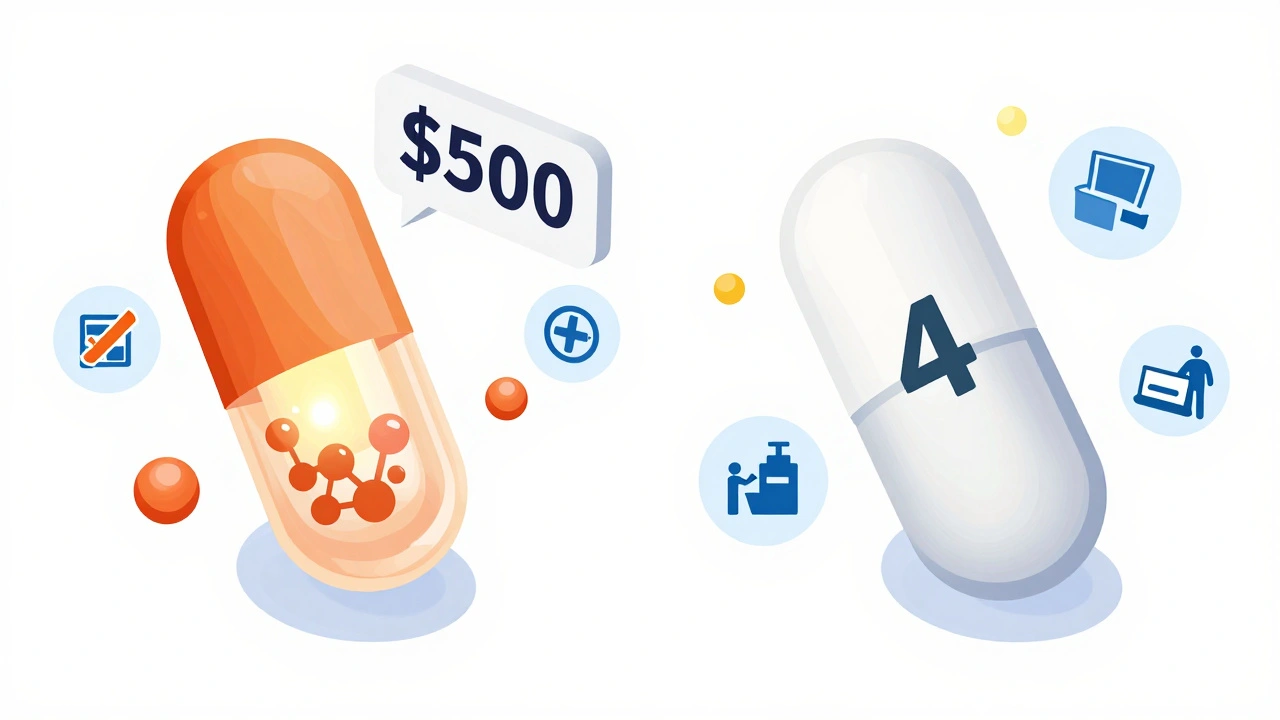
Have you ever looked at your prescription receipt and wondered why the generic version costs $4 while the brand-name version is $500? It’s not a trick. It’s not a scam. It’s just how the system works-and it’s designed to save you money without sacrificing safety or effectiveness.
Same medicine, different price tag
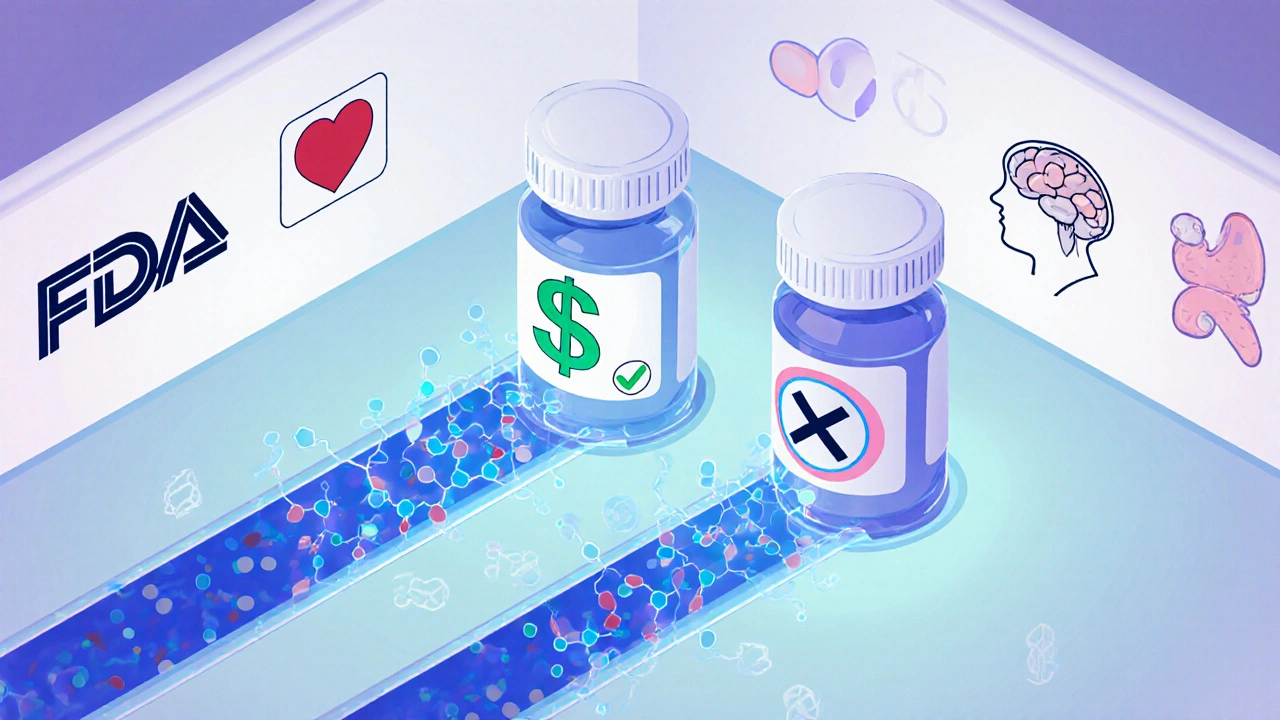
A generic drug isn’t a cheaper version of the real thing. It is the real thing. The active ingredient, the dose, how it works in your body, and how fast it gets into your bloodstream-all of it is identical to the brand-name drug. The FDA requires this. No exceptions. If a generic pill doesn’t deliver the same amount of medicine at the same rate as the brand, it doesn’t get approved.So why the massive price difference? The answer lies in what happens before the drug even hits the shelf.
Brand-name drugs: A $2.6 billion gamble
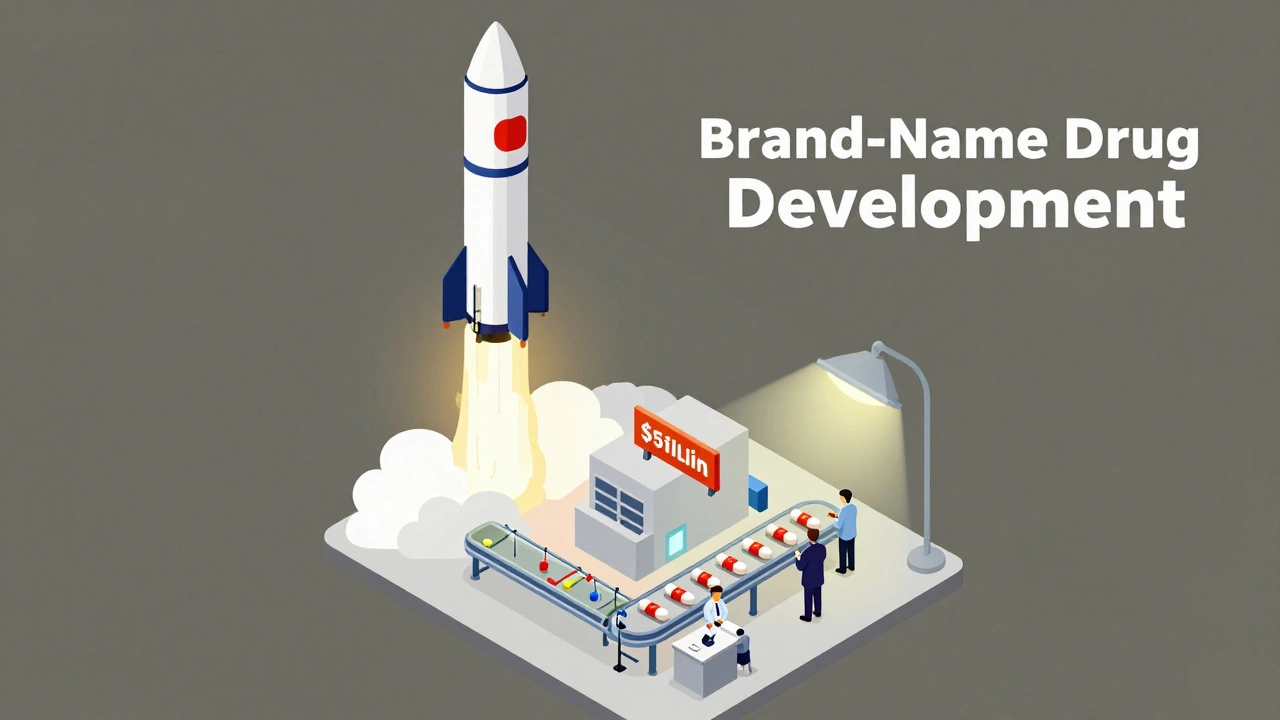
Developing a new brand-name drug is like launching a rocket. It takes 8 to 12 years. It costs an average of $2.6 billion. That money goes into years of lab research, animal testing, and multiple phases of human clinical trials. Companies test the drug on thousands of people to prove it’s safe and works better than a placebo. They also spend millions on marketing, packaging design, and building brand recognition.Once approved, the company gets a 20-year patent. That’s their monopoly window. No one else can make the same drug. That’s how they recoup their investment-and make a profit. During those 20 years, they charge whatever the market will bear. That’s why you see ads for drugs that cost $500 a month. The company has to cover those upfront costs and make money before competitors show up.
Generics: No need to reinvent the wheel
When the patent expires, other companies can step in. But here’s the key: they don’t have to repeat the 8-12 years of clinical trials. They don’t need to prove the drug works. They already know it does. All they need to prove is that their version behaves the same way in the body as the original. This is called bioequivalence.That’s it. No new animal studies. No massive human trials. Just a few hundred volunteers to show their pill releases the same amount of medicine at the same speed. That cuts development time from over a decade to under a year. And development costs? From $2.6 billion down to $1-5 million per drug.
That’s where the 80-85% savings come from. Generics don’t carry the burden of R&D debt. They don’t need to fund expensive ad campaigns. They don’t need fancy packaging. They just make the same medicine, cheaper.
Same rules, same factory standards
Some people worry that generics are made in cheaper, lower-quality factories. That’s not true. The FDA inspects every manufacturing facility-brand or generic-using the exact same standards. In 2023 alone, they conducted over 12,000 inspections worldwide. A generic pill made in India or China has to meet the same cleanliness, purity, and stability rules as one made in the U.S.Generics must also stay potent within 90-110% of the labeled strength throughout their shelf life. Same as brand-name drugs. The FDA doesn’t lower the bar. They just skip the expensive parts.
Why the pills look different
You might notice your generic pill is a different color, shape, or size than the brand. That’s because trademark laws prevent generics from looking exactly like the original. The active ingredient is the same, but the fillers, dyes, and coatings can differ. These don’t affect how the drug works-they’re just there to make the pill hold together or look different.Some people report feeling different after switching. That’s usually not because the medicine isn’t working. It’s because their body is reacting to a new coating, a different filler, or even the psychological effect of seeing a cheaper pill. Studies show 84% of patients believe generics are just as effective. But 37% still report side effects after switching-even when there’s no medical reason for it.
Who’s saving money-and how much
In the U.S., generics make up 90% of all prescriptions filled. But they account for only about 18% of total drug spending. That means brand-name drugs, which are only 10% of prescriptions, cost 82% of the money.Here’s what that looks like in real dollars:
- Generic atorvastatin (Lipitor): $4/month
- Brand-name atorvastatin: $500/month
- Generic omeprazole (Prilosec): $6/month
- Brand-name omeprazole: $300/month
- Generic levothyroxine (Synthroid): $10/month
- Brand-name levothyroxine: $400/month
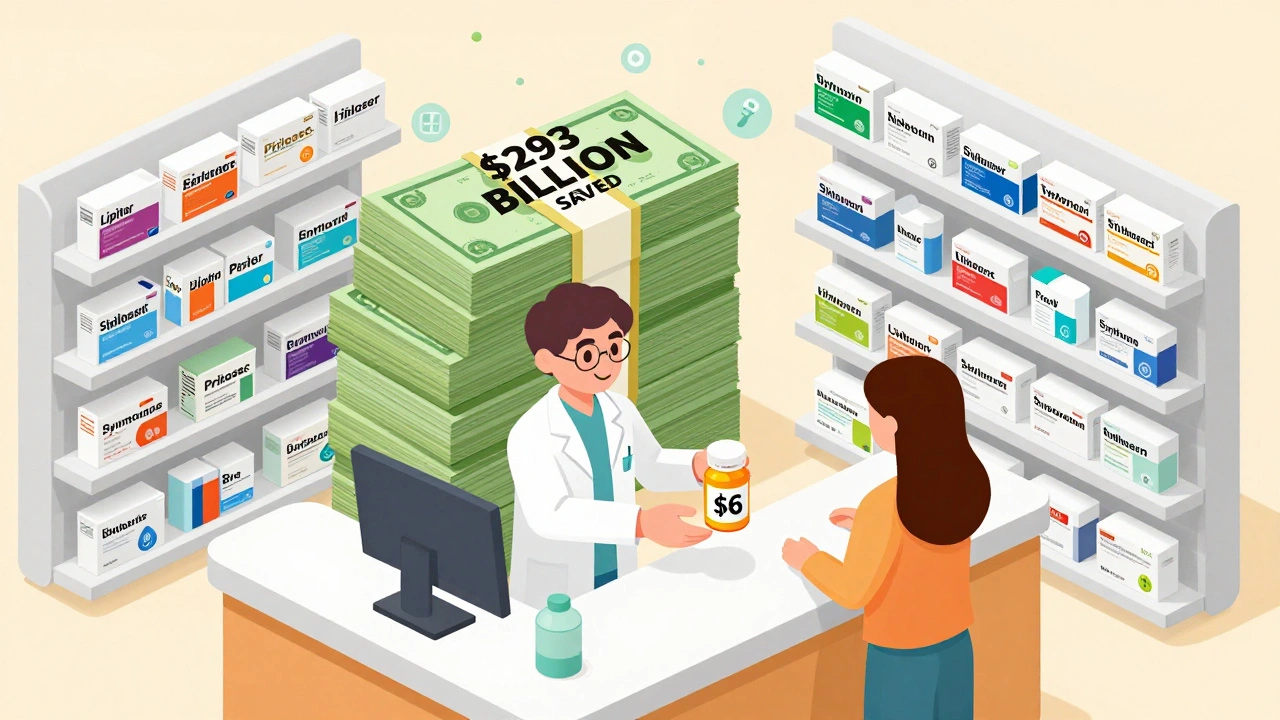
That’s not a typo. You’re paying 99% less for the same medicine. In 2022 alone, generic drugs saved the U.S. healthcare system $293 billion. That’s billions in out-of-pocket savings for patients, lower premiums for employers, and less strain on Medicare and Medicaid.
Insurance and pharmacy rules
Most insurance plans make it easy to choose generics. They put them in Tier 1-lowest copay. You might pay $0-$15 for a generic, but $25-$50 for the brand-name version. Some plans won’t cover the brand at all unless your doctor fills out extra paperwork.Pharmacists are allowed to swap a brand for a generic automatically in 49 states. If you ask for the brand, they’ll tell you it’ll cost more-and sometimes they’ll even suggest you ask your doctor if the generic is okay. That’s not pushy. It’s saving you money.
When to be cautious
For most drugs, switching is perfectly safe. But for a small group called “narrow therapeutic index” drugs-like warfarin, levothyroxine, or phenytoin-the difference between too little and too much is very small. Some doctors prefer to stick with one brand or generic manufacturer for these, just to reduce any possible variation.That doesn’t mean generics are unsafe. It means the body is extra sensitive to tiny changes in blood levels. Even then, the FDA says all approved generics meet the same standards. If you switch and feel off, talk to your doctor. Don’t assume the generic isn’t working. Sometimes it’s just your body adjusting.
What’s next for generics
More brand-name drugs are losing patents every year. In 2023, over 150 drugs with combined sales of $157 billion are set to go generic in the next few years. That means even bigger savings ahead.The FDA is also speeding up approval for complex generics-like inhalers, creams, and injectables-that used to take years to get approved. New rules aim to cut approval time from five years to two. That could save consumers another $50 billion a year.
And while most generic drugs are made overseas-70% of active ingredients come from China and India-the FDA still inspects those factories. Supply chain issues during the pandemic showed how fragile things can be, but the system is adapting.
Bottom line: You’re not getting less. You’re getting the same thing, for way less.
Generics aren’t a compromise. They’re the same medicine, made cheaper because the original company already paid the high cost of discovery. The system is designed so you benefit from that investment without paying for it twice.If your doctor prescribes a brand-name drug, ask: "Is there a generic?" If your pharmacist gives you a generic, don’t second-guess it. The color might be different. The shape might be weird. But the medicine? It’s the same. And that’s why millions of people save hundreds, even thousands, of dollars every year.

Carolyn Ford
December 4, 2025 AT 11:55Okay but let’s be real-why do pharmacies still push brand names if they know generics are identical? I’ve had pharmacists act like I’m asking for poison when I ask for the generic… like I’m some kind of drug-seeking villain. It’s not the patient’s fault the system’s rigged.
Heidi Thomas
December 6, 2025 AT 01:09Generics are just as good stop end of story
Alex Piddington
December 6, 2025 AT 22:13It’s important to recognize the systemic efficiency here. The FDA’s rigorous bioequivalence standards ensure therapeutic equivalence without redundant clinical trials. This model exemplifies rational resource allocation in pharmaceutical innovation. We benefit from the initial R&D investment while avoiding wasteful duplication.
Karl Barrett
December 7, 2025 AT 09:18What’s fascinating is the epistemological shift here: we’re conditioned to equate price with quality, yet the science says otherwise. The placebo effect isn’t just psychological-it’s sociocultural. We’ve been trained to distrust the plain pill because it lacks the branding aura of corporate prestige. The real tragedy? We’re paying for marketing, not medicine.
And yet, when you strip away the packaging, the ads, the celebrity endorsements, you’re left with molecules. Identical molecules. The same chemical handshake with your receptors. The same half-life. The same clearance rate.
It’s not a compromise. It’s a liberation. Liberation from corporate rent-seeking. Liberation from the myth that expensive = better. Liberation from the guilt of choosing ‘cheaper’ when ‘cheaper’ is scientifically indistinguishable.
The real question isn’t why generics are cheaper-it’s why we still feel guilty using them.
And don’t even get me started on the ‘narrow therapeutic index’ fearmongering. Yes, some drugs require monitoring-but that’s not a reason to deny access to affordable alternatives. It’s a reason to improve monitoring protocols, not to uphold monopolies.
The system isn’t broken. It’s just optimized for profit, not patient welfare. And until we decouple drug pricing from patent monopolies, we’ll keep paying for the dreams of investors, not the health of the public.
Generics are the quiet revolution we don’t celebrate enough.
Jake Deeds
December 8, 2025 AT 12:31Ugh, I just had to switch from Synthroid to generic levothyroxine last year… and yeah, I felt like a zombie for two months. My doctor said it was "just my mind," but I know better. I’m not some lab rat for Big Pharma’s cost-cutting experiment. I’ll pay the extra $390 a month if it means I don’t feel like I’m walking through molasses.
And don’t even get me started on how the FDA "inspects" factories in India. You think they’re checking every batch? Please. I’ve seen the videos. It’s a circus.
George Graham
December 9, 2025 AT 14:47I really appreciate how clear this breakdown is. I’ve been taking generic atorvastatin for five years now-no issues, no side effects, my cholesterol’s stable. My mom was convinced generics were "watered down," so I showed her the FDA data and she switched too. Now she says she feels better because she’s not stressed about the cost.
It’s wild how much stigma still exists around generics. I’ve had friends refuse them because "it’s not the same brand"-like the pill has a soul. But the science doesn’t care what color the capsule is.
Also, huge props to pharmacists who actually explain this stuff. Not enough of them do.
John Filby
December 11, 2025 AT 01:35Just switched to generic omeprazole last month and honestly? No difference. I used to feel guilty spending $300 a month on Prilosec… now I’m saving $294 and still not getting heartburn. 🙌
Also, side note: the generic version looks like a tiny blue football. I named it Barry. Barry the Pill. He’s my hero.
Elizabeth Crutchfield
December 11, 2025 AT 05:37i used to think generic was like a knockoff nike but turns out its just the same shoe with diff color laces?? mind blown. my blood pressure is fine now and i saved like 400 a month lol
Ben Choy
December 13, 2025 AT 00:12This is such an important topic. I’m from the UK and our NHS does this brilliantly-generics are the default unless there’s a clinical reason not to. It’s not about being cheap-it’s about being smart. More people get treated, more lives are saved, and the system doesn’t collapse under its own weight.
Also, I’ve had patients cry because they couldn’t afford the brand name. That’s not healthcare. That’s a moral failure.
Emmanuel Peter
December 14, 2025 AT 02:32Wait, so you’re telling me that after spending billions on R&D, the company just… walks away? And then some random factory in China makes the exact same thing for a fraction? That’s not capitalism-that’s socialism with a side of corporate betrayal. I’m not mad, I’m just disappointed. The system should reward innovation, not punish it.
Also, how do we know they’re not using recycled chemicals? I’ve seen TikTok videos.
Ollie Newland
December 14, 2025 AT 17:35There’s a reason the FDA doesn’t require full clinical trials for generics: the original trial data is already public. It’s not a loophole-it’s a feature. The system is designed to incentivize innovation while ensuring access. The real villain isn’t the generic manufacturer-it’s the patent extension tactics and evergreening that keep drugs expensive long after they should’ve gone generic.
And yes, the factories are inspected. Just because they’re overseas doesn’t mean they’re shacks. Some of the best pharma facilities in the world are in India. The FDA has inspectors stationed there full-time.
Benjamin Sedler
December 16, 2025 AT 11:14Ohhh so THAT’S why my generic Lexapro made me feel like a zombie? I thought it was my mental health… turns out it’s the dye. Or maybe the filler. Or the fact that it was made in a warehouse where a guy named Bob once sneezed on the conveyor belt. I’m switching back to the brand. I’d rather pay $400 than risk existential dread from a blue oval pill.
Also, I read somewhere that generics have 10% less active ingredient. Just saying.
Jordan Wall
December 17, 2025 AT 19:29As someone who’s worked in pharma regulatory affairs, I can tell you: the FDA’s bioequivalence standards are laughably lenient. ±20% variability? That’s not precision-that’s a gamble. And don’t get me started on the fact that generics can switch manufacturers mid-prescription. One month you get A, next month you get Z. No one tracks that. No one cares. But hey, at least it’s cheap.
Meanwhile, my son’s epilepsy meds? We stick with the brand. Because I’m not risking his life on a $6 pill with a questionable QC stamp.
Carolyn Ford
December 18, 2025 AT 22:47Wow, Jordan-you just confirmed everything I’ve been saying. If your son’s on epilepsy meds, you’re right to be cautious. But that’s why doctors have protocols. They don’t just hand out generics blindly for narrow therapeutic index drugs. The issue isn’t generics-it’s the lack of transparency when switching manufacturers. That’s the real problem.
And yes, ±20% variability sounds scary… until you realize that even brand-name drugs vary by 10-15% between batches. The system’s imperfect-but it’s not a conspiracy. It’s science with bureaucracy.