
Did you know that counterfeit medicines make up to 10% of the global pharmaceutical market? In some developing regions, that number jumps to 30%. This isn't just a statistic; it represents real risk to patients relying on their prescriptions. When you pick up a box of generic medicines, you expect the same active ingredients as the brand-name version. But with the rise of sophisticated fakes, checking the packaging and labeling has become a critical safety step for pharmacists and patients alike.
The challenge is real. Modern counterfeiters are getting better at copying labels. They replicate fonts, colors, and even security features. This means relying on a quick glance isn't enough anymore. We need a systematic approach to verification. This guide breaks down exactly how to spot the difference between a legitimate product and a dangerous fake, using the latest standards and tools available in 2026.
Why Generic Medicines Are Prime Targets
Generic medicines account for 90% of prescriptions in the U.S., yet they often cost significantly less than branded drugs. This high volume and lower profit margin create a specific vulnerability. Manufacturers might invest less in advanced security features for generics compared to high-margin branded drugs. Consequently, the supply chain for generics is often longer, passing through five to seven distribution points instead of three or four. Each handoff is an opportunity for tampering.
Counterfeit drugs are not just about money; they are about safety. The FDA warns that substandard and falsified medicines can lead to treatment failure, drug resistance, and even death. For example, a 2012 meningitis outbreak in the United States was linked to contaminated steroids, highlighting the catastrophic potential of supply chain breaches. Understanding this risk helps explain why verification protocols have tightened significantly over the last decade.
Visual Inspection: The First Line of Defense
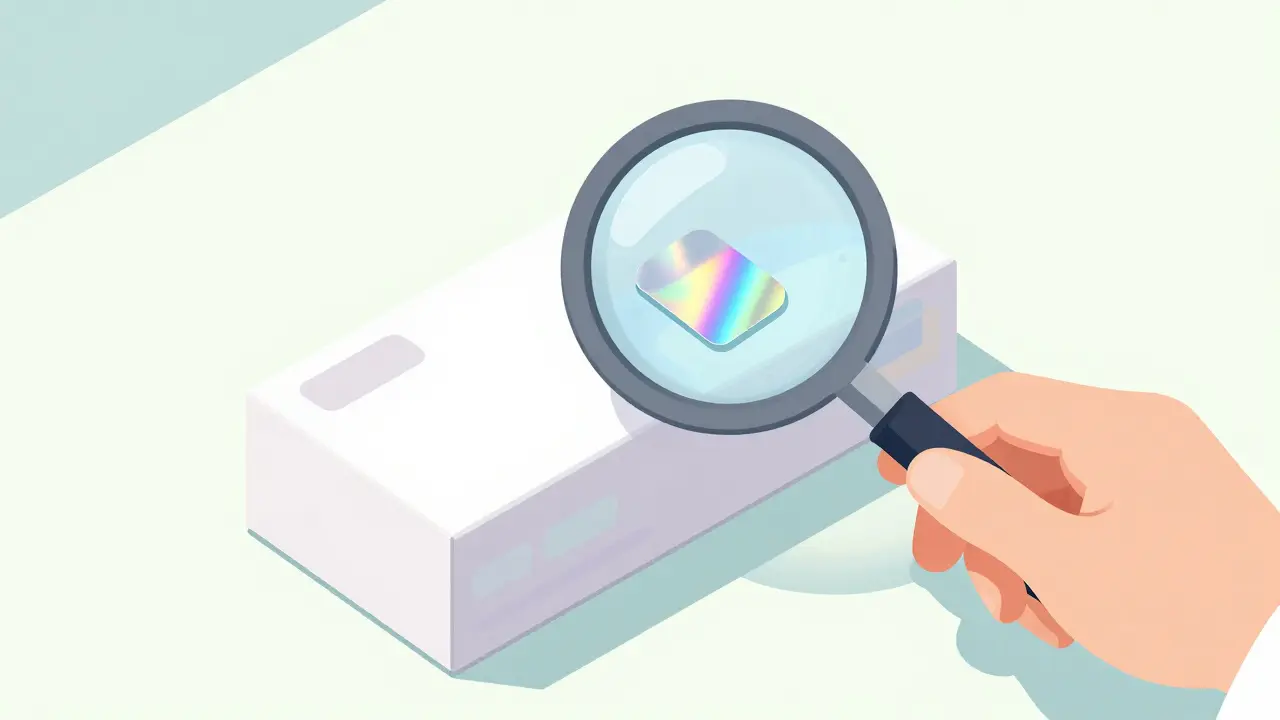
Before you reach for high-tech tools, you start with your eyes. Overt security features are designed to be visible without special equipment. These are the first clues that a package might be genuine. Look for color-shift inks that change appearance when you tilt the box. For instance, some packaging uses optically variable ink that shifts from green to blue. If the color stays flat, it raises a red flag.
Holograms are another common feature. Genuine holograms usually contain micro or nano text, typically between 50 to 100 micrometers in size. You can often spot these tiny details with a simple magnifying glass. Counterfeiters can replicate holograms with 80 to 90% accuracy, but the texture and depth often feel different. Run your finger over the surface. Authentic security features usually have a distinct tactile quality that cheap prints lack.
- Check for spelling errors or blurred text on the label.
- Verify the expiration date font matches the manufacturer's standard.
- Inspect the seal integrity to ensure the box hasn't been opened and resealed.
- Look for batch numbers and ensure they are printed clearly, not stamped poorly.
Covert Features and Simple Tools
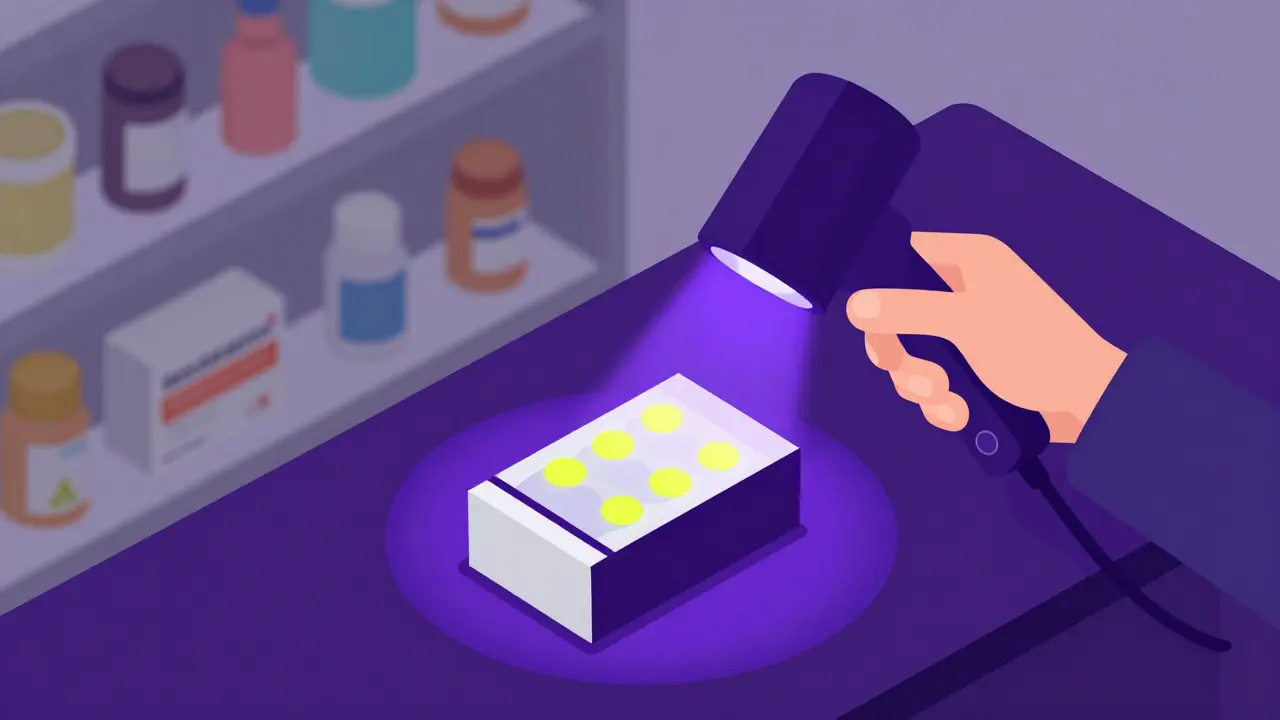
When visual inspection isn't enough, covert features come into play. These require simple tools but offer higher security than overt features. UV-sensitive inks are a prime example. Many companies, including Johnson & Johnson, have used UV markers on packaging since 2015. Under a 365nm ultraviolet light, hidden patterns or text appear. A basic UV light costs between $50 and $200, making it accessible for most community pharmacies.
Chemical taggants like Lumilink® UV markers are another layer. These require a handheld reader, costing around $200 to $500, to detect specific chemical signatures embedded in the ink. While not every pharmacy owns one, they are becoming more common in regional verification centers. The key takeaway is that if a package claims to have a UV feature but shows nothing under the light, the product is likely fake.
Track-and-Trace Systems and Serialization
Modern verification relies heavily on digital tracking. The U.S. Drug Supply Chain Security Act (DSCSA) mandated product tracing through the supply chain by November 27, 2023. This means every prescription package should have a unique serial number following the GS1 standard. These numbers allow pharmacies to query a database and confirm the product's journey from the factory to the shelf.
However, implementation varies. Trustpilot reviews of verification apps note that barcode scanning works well for branded drugs but fails 40 to 50% of the time with generics due to inconsistent serialization. This is a known pain point. The Generic Pharmaceutical Association aims for 100% serialization of all generic medicines in the U.S. by 2026. Until then, pharmacists must be prepared for gaps in the digital trail. If a serial number doesn't check out, do not dispense the medication. Contact the supplier immediately.
Advanced Technology: Spectroscopy in the Field
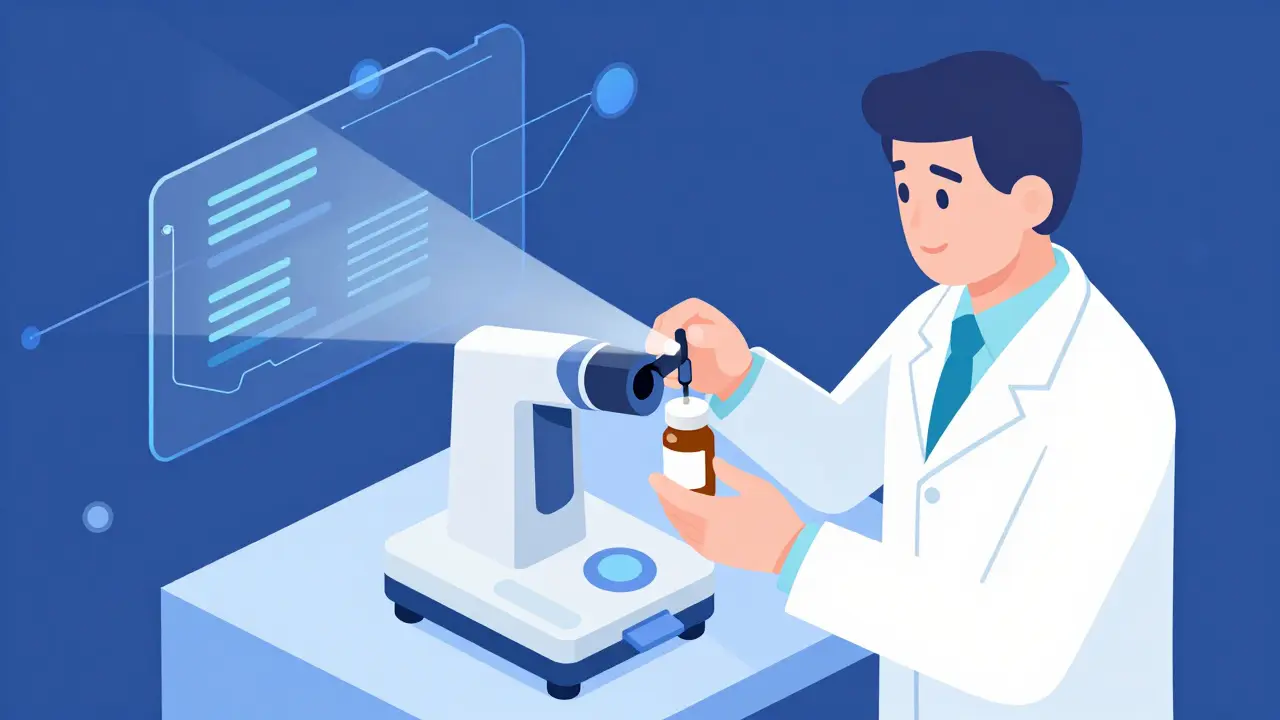
For the highest level of certainty, spectroscopic methods are the gold standard. Handheld NIR spectroscopy devices, such as the Thermo Fisher® TruScan® RM, weigh about 1.4 kg and analyze a sample in 10 to 30 seconds. These devices detect physicochemical differences invisible to the naked eye. A correlation coefficient below 0.85 reliably indicates a counterfeit product.
Raman spectroscopy is another option, with devices like the B&W Tek® NanoRam®. It identifies specific chemical constituents but can struggle with dark-colored tablets due to fluorescence interference. While these devices cost between $15,000 and $50,000, hospitals and large chains are investing in them. A 2023 study found that combined approaches using both overt features and spectroscopic verification achieved a 98.7% counterfeit detection rate, compared to 82.4% for single-method approaches.
| Technology | Cost Range | Accuracy | Best For |
|---|---|---|---|
| Visual Inspection | $0 - $50 | 70-80% | Quick patient checks |
| UV Light | $50 - $200 | 85-90% | Pharmacy counter checks |
| NIR Spectroscopy | $15,000 - $50,000 | 92-97% | Field verification of generics |
| Raman Spectroscopy | $20,000 - $60,000 | 88-94% | Chemical constituent ID |
Regulatory Landscape and Compliance
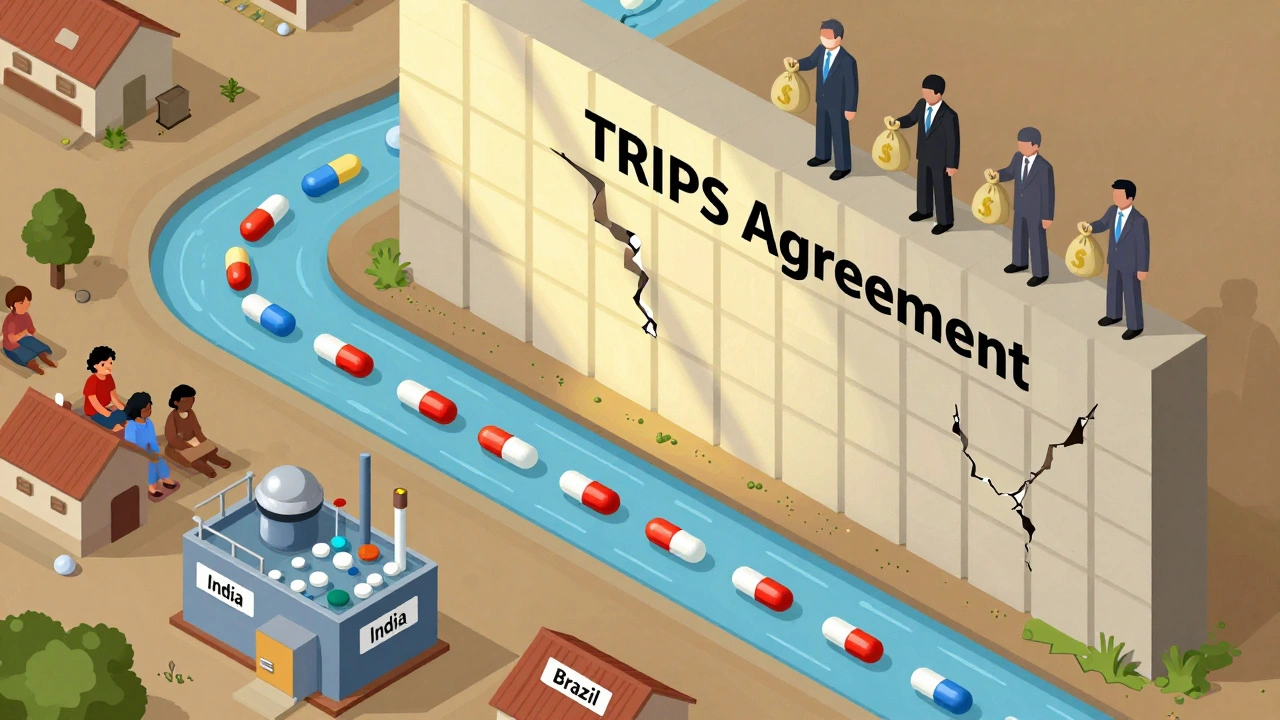
Regulations drive the verification standards we use today. The European Union Falsified Medicines Directive (FMD) required all prescription medicines to implement safety features by February 9, 2019. This set a baseline for 32 European countries. The European Medicines Verification System (EMVS) now processes over 2.5 billion verification requests annually with 99.998% uptime.
In the United States, the FDA's Product Quality Research Institute established minimum performance standards in 2018. Verification systems must achieve at least 95% accuracy in distinguishing authentic from counterfeit products under field conditions. However, compliance is not uniform globally. The WHO notes that 137 countries have implemented some form of medicine verification requirements as of 2023, but implementation varies widely. The EU achieves 98% compliance among manufacturers, while Southeast Asia sits at 45%.
Practical Steps for Pharmacists and Patients
If you are a pharmacist, start by establishing a regional verification protocol. The FDA's 2022 verification toolkit outlines a 12-step implementation process. Basic equipment like UV lights and magnifiers costs under $200 for small pharmacies. Training is minimal for visual checks, taking only 1 to 2 hours. For spectroscopic equipment, expect 8 to 16 hours of training to reach 90% proficiency.
Patients can also play a role. Ask your pharmacist if they verify the packaging. Check the seal yourself before leaving the counter. If you buy online, ensure the site is accredited. The National Community Pharmacists Association found that 68% of independent pharmacists reported difficulty verifying generic medicines compared to 22% for branded products. The primary challenge is inconsistent application of security features. If something feels off, trust your instinct and ask for a replacement.
How can I tell if a generic medicine is counterfeit?
Look for inconsistencies in packaging such as spelling errors, poor print quality, or missing security features like holograms. Check the expiration date font and ensure the seal is intact. If available, use a UV light to check for hidden inks.
What is the most accurate way to verify medicines?
Spectroscopic methods like NIR spectroscopy offer the highest accuracy, achieving 92-97% detection rates. These tools analyze the chemical composition of the pill itself, which is more reliable than packaging checks alone.
Do all generic medicines have track-and-trace codes?
Not yet. While the U.S. aims for 100% serialization by 2026, currently only about 55-65% of generics have consistent serialization. Branded drugs are more likely to have these codes than generic versions.
Why are generic medicines more prone to counterfeiting?
Generics represent 90% of prescriptions but have lower profit margins. Manufacturers may invest less in security features, and the supply chain often involves more distribution points, increasing opportunities for tampering.
What should I do if I suspect a drug is fake?
Do not consume the medication. Contact your pharmacist or the manufacturer immediately. In the U.S., you can report suspected counterfeits to the FDA MedWatch program. Keep the packaging for analysis.
The fight against counterfeit drugs requires constant vigilance. Technology is advancing, with blockchain-based verification showing 99.2% accuracy in recent pilot programs. But until global standards harmonize, the responsibility falls on the people handling the medicine. Whether you are a pharmacist using a handheld spectrometer or a patient checking a label, your attention to detail saves lives. Stay informed, use the tools available, and never hesitate to question a product that doesn't look right.
Raphael Schwartz
March 26, 2026 AT 00:47imported meds are garbge and shold be banned.
Kevin Y.
March 26, 2026 AT 21:11It is indeed imperative that we adhere to these verification protocols strictly. The integrity of the pharmaceutical supply chain is paramount for public health. We must collaborate to ensure safety standards are met.
Marissa Staples
March 27, 2026 AT 00:42I guess we just have to hope the pharmacist checks it properly for us.
Agbogla Bischof
March 28, 2026 AT 10:09It is vital, to understand, the nuances, of the supply chain. Many people overlook the distribution points. Each point introduces risk. We must verify every step. The DSCSA is a good start. But compliance varies globally. The EU has better systems. We need to adopt those standards. Spectroscopy is the gold standard. However, cost is a barrier. Community pharmacies struggle with this. Training is essential for staff. Patients should be educated too. Visual checks are not enough anymore. We need a multi-layered approach. Safety cannot be compromised. The statistics are alarming. Counterfeits cause real harm. We must act now. Thank you for sharing this data.
peter vencken
March 28, 2026 AT 17:51I work in the industry and can say the tech is getting better but still lagging on generics.
Donna Fogelsong
March 30, 2026 AT 01:19big pharma controls the nodes and hides the data from the public eye
Jefferson Moratin
March 31, 2026 AT 15:28The ethical implication of falsified medicine extends beyond economics into the realm of human rights. We must consider the moral weight of our regulatory choices.
Jesse Hall
April 2, 2026 AT 08:51This is super important info for everyone to read :) Keep staying safe out there!
Mihir Patel
April 2, 2026 AT 16:09This is absolutely terrbile and makes me so worried about my family health!!!
Chris Crosson
April 3, 2026 AT 03:32We need stricter enforcement on the manufacturers side to ensure compliance.
Katie Putbrese
April 4, 2026 AT 08:04People need to stop buying cheap meds from shady sites or you are risking your own life.
Caroline Dennis
April 6, 2026 AT 01:07Pharmacovigilance protocols require immediate implementation of serialization standards.