
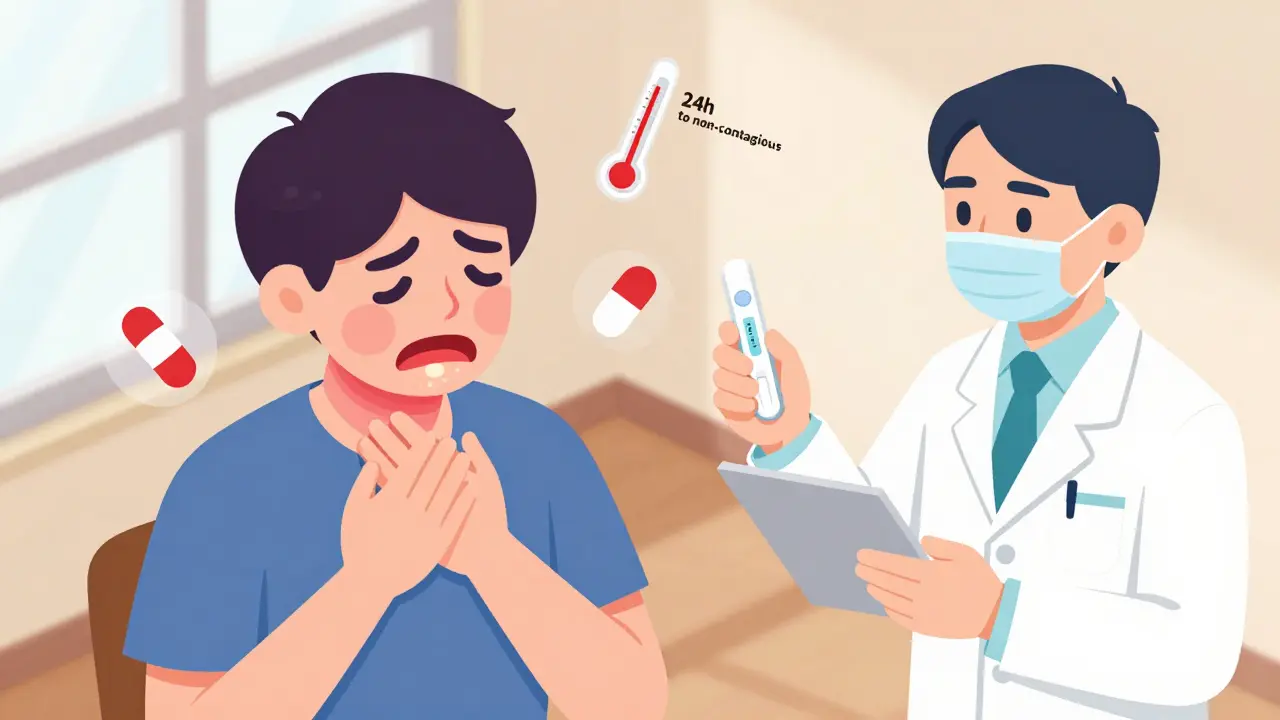
When your throat suddenly feels like sandpaper and swallowing hurts so bad you avoid even sipping water, it’s easy to blame a cold or allergies. But if you’re also running a fever, have no cough, and your tonsils look like they’re covered in white patches, you might be dealing with strep throat-a bacterial infection that needs the right treatment, fast.
Unlike viral sore throats that clear on their own, strep throat won’t get better without antibiotics. Left untreated, it can lead to serious problems like rheumatic fever, which can damage your heart valves. The good news? With the right diagnosis and treatment, most people bounce back in under a week. Here’s exactly what you need to know about getting diagnosed, choosing the right antibiotic, and knowing when you’re truly back to normal.
How Doctors Tell Strep Throat from a Cold
Strep throat isn’t just a bad sore throat. It’s caused by Group A Streptococcus bacteria, and it shows up with a very specific set of signs. The most telling ones? A sudden, severe throat pain, a fever over 100.4°F (38°C), swollen tonsils with white patches, and tender lymph nodes under your jaw. You’ll notice one big thing missing: no cough, no runny nose, and no red eyes. That’s the key.
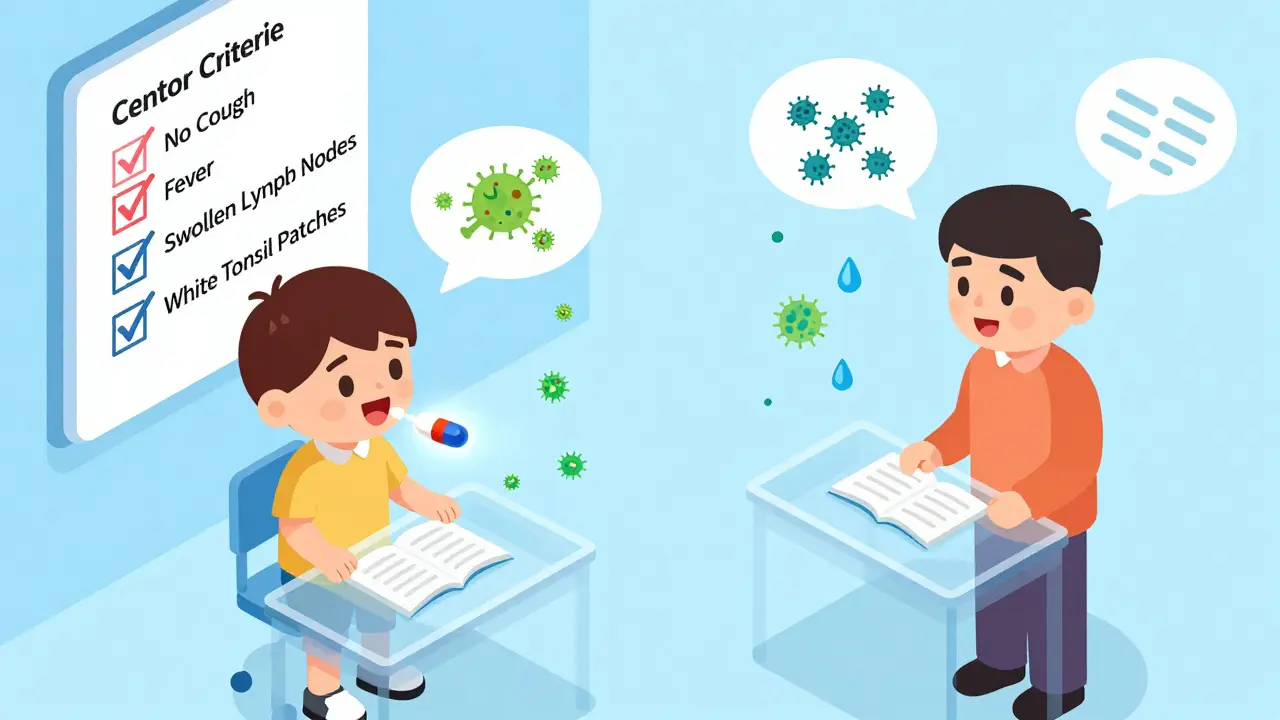
Here’s why that matters: if you have a cough or congestion, it’s almost certainly a virus. Studies show that the absence of cough is 90% specific for strep throat. That’s why doctors don’t just guess-they use a scoring system called the Centor criteria. You get one point each for:
- No cough
- Fever above 100.4°F
- Tender swollen lymph nodes in the neck
- White patches or swelling on the tonsils
If you score 3 or higher, there’s a 40-60% chance you have strep. That’s when testing kicks in. But here’s the catch: not everyone needs a test. Kids under 3 almost never get strep. And in adults with low scores, testing often isn’t worth it-because the risk of complications is low.
Testing: Rapid Tests, Cultures, and New Tech
There are three main ways to confirm strep throat. The first is the rapid antigen test (RADT). It’s fast-results in 10 to 30 minutes-and over 95% accurate if it comes back positive. But it can miss up to 15% of cases, especially in young kids. That’s why guidelines say: if a child or teen tests negative but still looks like they have strep, they need a throat culture.
The throat culture is the gold standard. You swab the back of the throat, send it to the lab, and wait 18 to 48 hours. It catches nearly all cases, but it’s slow. That’s why many clinics now use molecular tests (PCR), which are even more sensitive than cultures. They’re 95-98% accurate and give results in 24 to 48 hours. The downside? Cost and availability.
As of early 2026, a new test called Strep Ultra hit the market. Approved by the FDA in March 2024, it gives 98% accuracy in just 15 minutes. It’s starting to show up in urgent care centers and pediatric offices, and by 2026, it could replace older rapid tests in many places.
Which Antibiotics Work-and Which Don’t
Penicillin or amoxicillin are still the first choices. Why? They’re cheap, effective, and resistance is extremely rare. For adults, it’s 500 mg of penicillin V twice a day for 10 days. For kids, it’s 250 mg twice a day. Amoxicillin is often used for kids because it tastes better and can be given once daily. Both clear the infection in 95% of cases when taken fully.
If you’re allergic to penicillin, options include:
- Cephalexin (a first-gen cephalosporin)-safe for most penicillin allergies
- Clindamycin-used when other options fail, but resistance is rising
- Azithromycin (Z-pack)-convenient (5 days), but only 85-90% effective and more likely to fail
Here’s what you need to know: macrolide antibiotics like azithromycin have resistance rates as high as 15% in some areas. That means if you’ve taken one before, it might not work. Clindamycin resistance is also creeping up-now seen in 5-10% of cases in certain communities.
And here’s a big one: never use leftover antibiotics. A CDC survey found 12% of people do this. That’s how resistance builds. If you have an old bottle of amoxicillin from last year, throw it out. Don’t share it. Don’t guess the dose.
What Happens After You Start Antibiotics
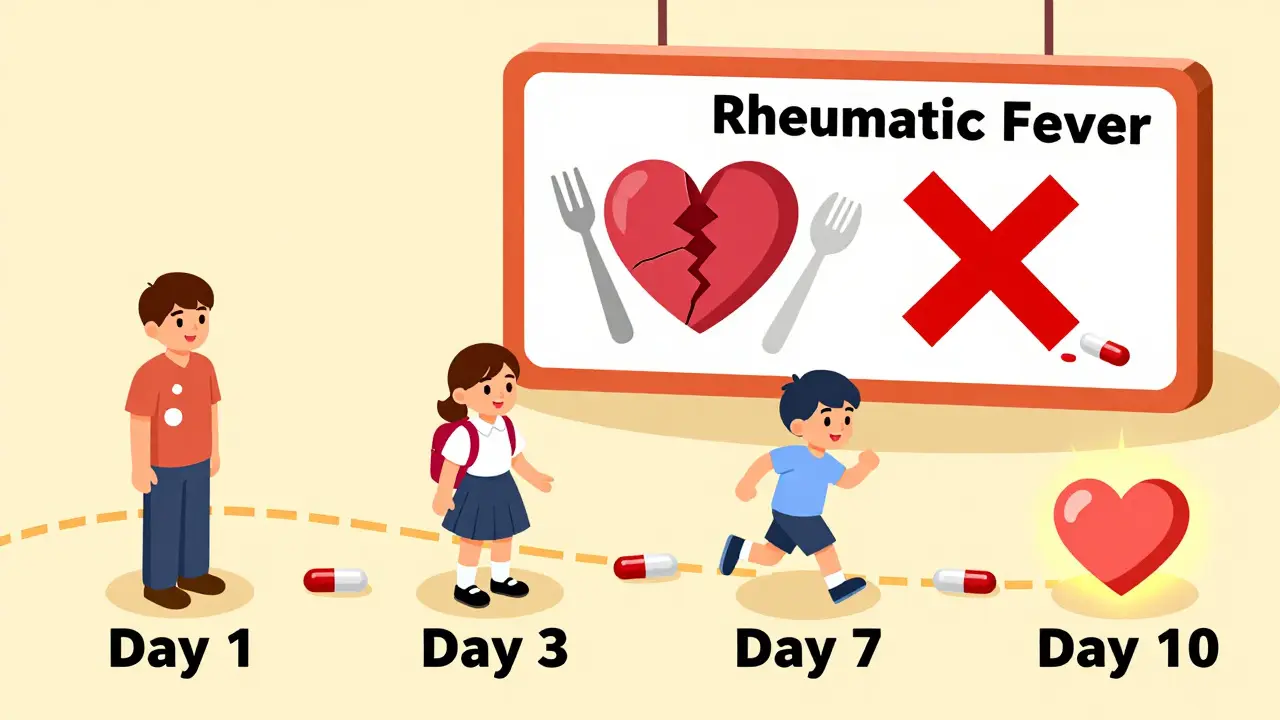
Most people feel better within 24 to 48 hours. The fever drops. Swallowing gets easier. That doesn’t mean you’re cured. You still have bacteria in your throat. That’s why you finish the full 10-day course-even if you feel fine on day 5.
Here’s the timeline:
- Day 1-2: Antibiotics start working. Fever breaks. Pain eases.
- Day 3-4: You’re no longer contagious. You can return to school or work if you’re fever-free.
- Day 5-7: Symptoms mostly gone. Energy starts returning.
- Day 8-10: Full recovery. Swallowing normal. No more white patches.
Without antibiotics, symptoms last 7-10 days-and you’re contagious the whole time. With antibiotics, you stop spreading the infection within 24 hours. That’s why schools and workplaces require you to stay home until you’ve been on antibiotics for at least a day.
When You Should Worry (Red Flags)
Most cases resolve fine. But watch for these signs:
- Fever returns after improving
- Difficulty swallowing or breathing
- Severe one-sided throat pain (could be a peritonsillar abscess)
- Rash, swelling, or joint pain (signs of rheumatic fever)
- Symptoms lasting more than 48 hours after starting antibiotics
Peritonsillar abscesses happen in 1-2% of cases. They’re serious. If your throat pain suddenly gets worse on one side and you can’t open your mouth fully, go to the ER. Same goes for trouble breathing or a rash that looks like sandpaper-that’s scarlet fever, a complication of strep.
Why People Don’t Get Better (And What to Do)
One in five people who take antibiotics for strep don’t fully recover. Why? Mostly because they stop early. A 2023 study in JAMA Pediatrics found that 40% of parents quit antibiotics when their child seemed better-even if the course wasn’t done. That’s why relapse happens in 5-15% of cases.
Other mistakes:
- Sharing antibiotics with family members (8% of adults admit to this)
- Using old prescriptions instead of seeing a doctor
- Assuming a negative rapid test means no strep (especially in kids)
If you’re not improving after 48 hours on antibiotics, call your doctor. You might need a different antibiotic-or further testing for complications.
Prevention and Long-Term Risks
Strep spreads through droplets-coughs, sneezes, shared utensils. Wash your hands. Don’t kiss someone with strep. Don’t share drinks. Kids in daycare and school are the main spreaders.
The real danger isn’t the sore throat. It’s what happens if it’s ignored. Rheumatic fever affects about 3% of untreated cases. It can cause permanent heart damage. That’s why the WHO lists strep throat prevention as a global priority. Every year, 325,000 children worldwide develop rheumatic heart disease because of untreated strep.
There’s no vaccine yet. Researchers are trying, but the bacteria has over 200 different strains. That makes it hard to design one shot that works for everyone. Until then, the best defense is quick diagnosis and full antibiotic treatment.
Costs and Real-World Challenges
Strep throat drives 15 million U.S. doctor visits every year. The cost? $350 million annually. A rapid test runs $25-$50. Penicillin? As low as $4 for a full 10-day course. Azithromycin? Up to $250 if you don’t have insurance.
And here’s something most people don’t realize: antibiotic resistance is growing-not for penicillin, but for the alternatives. Macrolides and clindamycin are seeing higher failure rates. That’s why doctors are cautious about prescribing them. The CDC is now tracking resistance patterns with a $15 million investment, and new guidelines are expected in 2026.
Can you get strep throat without a fever?
It’s rare. Fever above 100.4°F is one of the top signs of strep throat, present in 85% of confirmed cases. If you have a sore throat with no fever, it’s far more likely to be viral. However, some adults-especially those with weaker immune systems-can have strep without a high fever. If other symptoms match (no cough, swollen tonsils, tender lymph nodes), testing is still recommended.
Is strep throat contagious after 24 hours of antibiotics?
No. Once you’ve taken antibiotics for at least 24 hours and your fever is gone, you’re no longer contagious. That’s why most schools and workplaces allow you to return after one full day of treatment. But you still need to finish the entire course to prevent relapse or complications.
Why is penicillin still the best choice for strep throat?
Penicillin has been used for over 70 years to treat strep throat, and resistance remains under 0.5%. It’s highly effective, safe, and cheap. Alternatives like azithromycin are convenient but less effective and more expensive. Unless you have a true penicillin allergy, penicillin or amoxicillin is the smartest, most proven option.
Can adults get strep throat more than once?
Yes. Having strep once doesn’t give you lifelong immunity. You can get it again, especially if you’re around children or in close quarters like offices or gyms. Adults get strep less often than kids, but 5-15% of adult sore throats are still bacterial. If you’ve had it twice in one year, your doctor may check for a carrier state or underlying immune issue.
What if I’m allergic to penicillin but the alternatives didn’t work?
If first-line alternatives like cephalexin or azithromycin fail, your doctor may test for clindamycin sensitivity or consider a different class of antibiotics. In rare cases, a throat culture and sensitivity test will be done to find exactly which drug works. Never self-prescribe or switch drugs without medical advice-this increases resistance risk.
Milad Jawabra
March 5, 2026 AT 15:43Bro, I had strep last winter and skipped the antibiotics because I "felt fine" after 3 days. Big mistake. Fever came back, throat closed up, and I ended up in urgent care with a peritonsillar abscess. Don’t be me. Finish the damn course. Your tonsils will thank you.
Raman Kapri
March 7, 2026 AT 03:37While the article presents a clinically conventional perspective, it fails to critically interrogate the structural determinants of antibiotic overprescription in primary care settings. The implicit assumption that compliance with biomedical protocols is sufficient to mitigate resistance neglects socioeconomic drivers of self-medication and healthcare access disparities.
Divya Mallick
March 7, 2026 AT 16:09OMG I CANNOT BELIEVE PEOPLE ARE STILL USING PENICILLIN IN 2026?? 😭 Like, are we living in 1953? Azithromycin is the future, and if you're not on a Z-pack, you're basically just waiting for the bacteria to laugh at you. Also, I got strep THREE times last year and my doctor said I'm a "chronic carrier"-which I think means my body is just too dramatic for this world. #StrepQueen
Pankaj Gupta
March 8, 2026 AT 14:24There is a notable discrepancy in the article's treatment of penicillin resistance. While it states resistance remains under 0.5%, recent data from the WHO Global Antimicrobial Resistance and Use Surveillance System (GLASS) indicates that in certain regions, including parts of South Asia, macrolide resistance exceeds 30%, and clindamycin resistance is rising in community-acquired strains. The recommendation to avoid alternatives without medical oversight is sound, but the framing overlooks regional variation in resistance profiles.
Alex Brad
March 8, 2026 AT 16:59Finish the antibiotics. No exceptions.
RacRac Rachel
March 9, 2026 AT 05:52I’m so glad this exists! I’ve had strep twice, and the second time I was terrified I’d end up with rheumatic fever like my grandma did in the 70s. 🥹 I followed every step-got the rapid test, took every pill, stayed home until day 3. It sucked, but I felt like a superhero. Also, wash your hands like your life depends on it-because it kinda does. 💪❤️
Richard Elric5111
March 11, 2026 AT 01:48The ontological framing of streptococcal infection as a pathological entity requiring pharmacological intervention presupposes a Cartesian dualism between the human body and microbial agency. One must interrogate whether the clinical imperative to eradicate Group A Streptococcus-rather than coexist with it as part of the human microbiome-reflects a pathological anthropocentrism. The historical triumph of penicillin may have inadvertently precipitated a crisis of microbial adaptation, wherein human medical hegemony is now being renegotiated through evolutionary pressure. Perhaps the true remedy lies not in antibiotic escalation, but in epistemological humility.
Dean Jones
March 12, 2026 AT 13:57Look, I get it-antibiotics save lives. But let’s be real: we’ve been treating strep like it’s the plague since the 1940s, and we’re still here. The real issue isn’t whether you take the full course-it’s why we treat a common, mostly benign infection like a death sentence. I’ve seen people get diagnosed with strep after a 30-second exam and a rapid test that’s wrong 15% of the time. Meanwhile, the CDC is throwing millions at resistance tracking while ignoring the fact that 70% of sore throats are viral. We’re overtesting, overtreating, and overmedicating because we’re scared of the word "complication." But the complication isn’t strep-it’s our fear of uncertainty. I’ve had strep twice. I didn’t take antibiotics either time. I drank tea, slept, and waited. I didn’t die. My tonsils didn’t melt. I just got better. Maybe the real lesson here is: trust your body more than your doctor’s algorithm.
Betsy Silverman
March 13, 2026 AT 18:59As someone who grew up in a household where antibiotics were handed out like candy, this post hit home. My mom used to give my brother leftover amoxicillin for every sniffle. I’m so glad we’re moving toward better education. I’ve started telling my kids: "If your throat hurts, we go to the doctor. We don’t raid the medicine cabinet." It’s small, but it matters. Also, the part about not sharing drinks? I’m now the "no sharing water bottles" enforcer at the gym. 🙌
Ivan Viktor
March 15, 2026 AT 18:48So let me get this straight-spending $250 on azithromycin because you don’t want to take penicillin twice a day for 10 days is the modern American way? I’ve got a 10-day course of penicillin for $4. You’ve got a 5-day Z-pack for $250. Guess which one’s gonna be the next meme on TikTok? "When you think you’re too cool for penicillin but your throat still looks like a horror movie." Also, I’m 34. I’ve had strep 4 times. I’ve never taken antibiotics. I’ve never missed work. Just ice chips, saltwater, and patience. Maybe the real epidemic is anxiety, not bacteria.
Jeff Card
March 17, 2026 AT 07:42Just wanted to say thank you for writing this. I’m a nurse, and I see people come in scared, confused, or just plain tired of being told "it’s probably just a virus." This article gives people real, clear info without the fear-mongering. The part about kids under 3 rarely getting strep? I’ve had parents panic because their toddler had a sore throat-I can now point them here. And the warning about leftover meds? I’ve personally thrown out 12 bottles in the last year. Please, please, don’t keep them. Your future self will thank you.