
Simvastatin Interaction Checker
Simvastatin Dose
Your Current Medications
Check all medications you're currently taking
Simvastatin is one of the most common cholesterol-lowering pills prescribed worldwide. But if you're taking it - especially at 40 mg or 80 mg - and you're also on another medication, you could be in serious danger. This isn't theoretical. People have ended up in the hospital with muscle breakdown so severe it damaged their kidneys. Some didn't survive. The risk isn't just possible. It's documented, measured, and preventable.
Why Simvastatin Is Different From Other Statins
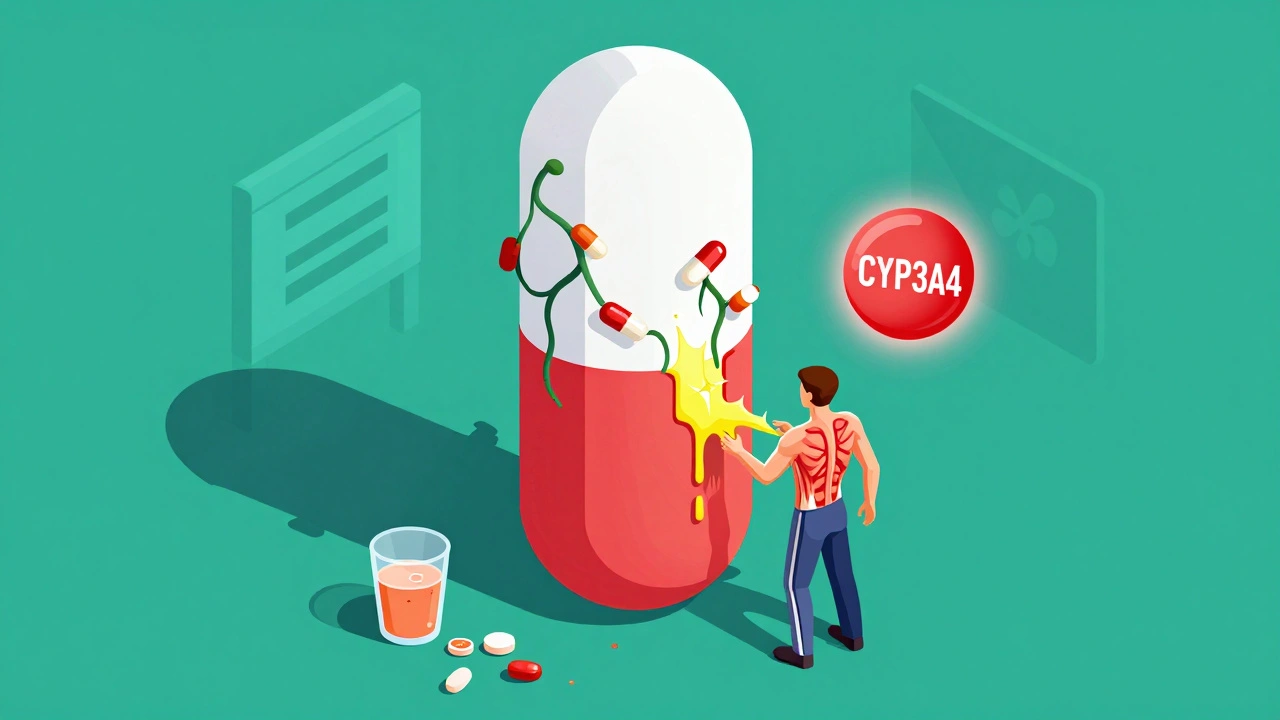
Not all statins are made the same. Simvastatin is broken down in your liver by an enzyme called CYP3A4. That’s fine - until something else blocks that enzyme. When that happens, simvastatin builds up in your blood. Like a clogged drain, the drug can’t leave your system fast enough. That’s when muscle damage, liver stress, and even death become real risks.Compare that to rosuvastatin or pravastatin. They don’t rely on CYP3A4. That’s why doctors now often switch patients off simvastatin if they need long-term treatment with other medications. Simvastatin’s metabolism is its weakness.
The 80 mg Dose Is a Red Flag
The FDA didn’t just warn about simvastatin. They specifically targeted the 80 mg dose. In 2011, after reviewing thousands of adverse event reports, they found the 80 mg dose had a 7.6 times higher risk of rhabdomyolysis than lower doses. That’s not a small increase. It’s a massive spike.Before 2011, 80 mg was sometimes used for patients with very high cholesterol. Now? It’s almost never started. The American College of Cardiology says don’t begin anyone on 80 mg. If you’re already on it, your doctor should be evaluating whether you really need that dose - or if you can drop to 20 mg or 40 mg safely.
Studies show the risk isn’t just theoretical. In the SEARCH trial, patients on 80 mg had a 0.61% chance of developing severe muscle damage. At 20-40 mg? Just 0.08%. That’s a 7.5-fold difference. And in real-world data, over 60% of rhabdomyolysis cases linked to simvastatin happened at doses of 40 mg or higher.
These Drugs Can Kill You With Simvastatin
Some medications don’t just interfere with simvastatin - they turn it into a time bomb. Here are the top offenders:- Clarithromycin and erythromycin - antibiotics for sinus infections or pneumonia. One dose can push simvastatin levels over the edge. Cases have been reported where patients developed muscle pain and weakness within 72 hours of starting the antibiotic.
- Ketoconazole, itraconazole, voriconazole - antifungals used for stubborn yeast or fungal infections. These are absolute no-gos with simvastatin, especially at 80 mg.
- Cyclosporine - used after organ transplants. Patients on both drugs have developed fatal rhabdomyolysis. One study showed a 10-fold increase in simvastatin blood levels when taken together.
- HIV protease inhibitors - drugs like ritonavir, atazanavir, darunavir. These are among the strongest CYP3A4 blockers known. Even 10 mg of simvastatin can be too much.
- Diltiazem and verapamil - blood pressure meds. The FDA says if you must take them with simvastatin, never exceed 10 mg daily.
- Amiodarone and amlodipine - heart rhythm and blood pressure drugs. Maximum simvastatin dose? 5 mg.
And yes - even colchicine, a common gout medication, has been tied to muscle damage when combined with simvastatin. It’s not just the big drugs. It’s the ones you might not think twice about.
Grapefruit Juice Isn’t Just a Warning - It’s a Hazard
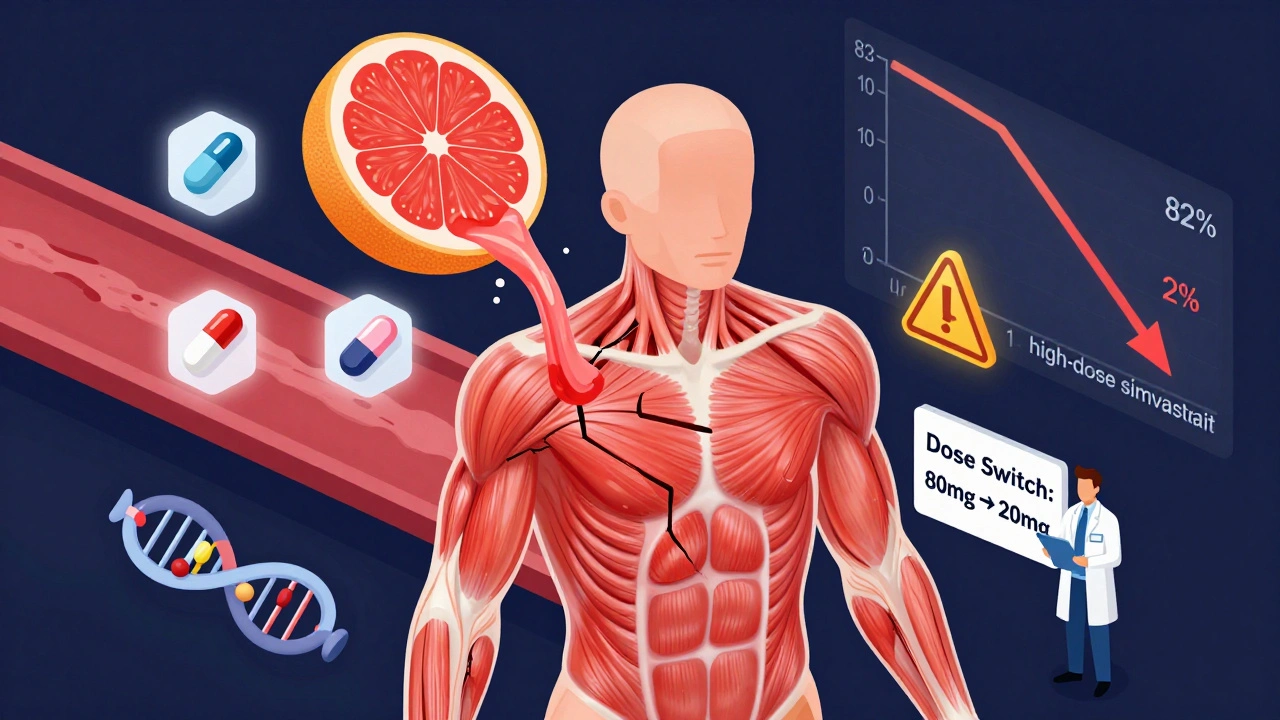
You’ve probably heard you shouldn’t drink grapefruit juice with statins. But with simvastatin, it’s not a suggestion - it’s a life-or-death rule.A single 8-ounce glass of grapefruit juice can boost simvastatin levels in your blood by up to 260%. That’s not a little bump. That’s enough to push you from safe to dangerous. And it doesn’t matter if you drink it in the morning and take your pill at night. The enzyme-blocking effect lasts over 24 hours.
One study found 43% of patients on high-dose simvastatin still drank grapefruit juice - even after being told not to. They thought a little wouldn’t hurt. It did. Pharmacists report patients showing up with muscle pain, dark urine, and weakness - all after continuing grapefruit juice despite warnings.
What to Do If You’re on Simvastatin
If you’re taking simvastatin, here’s what you need to do right now:- Check your dose. If you’re on 80 mg, ask your doctor if you can switch to 20 mg or 40 mg. Most people don’t need the highest dose.
- Review every medication. This includes prescriptions, over-the-counter drugs, and supplements. Don’t forget herbal products - St. John’s wort can also interfere.
- Avoid grapefruit juice completely. No exceptions. Not even a splash in your smoothie.
- Get liver tests. Your doctor should check your ALT and AST levels every 3 to 6 months. If they rise above 3 times the normal limit, your dose may need to change.
- Know the warning signs. Unexplained muscle pain, weakness, or dark urine? Call your doctor immediately. These could be early signs of rhabdomyolysis.
Alternatives Exist - And They’re Safer
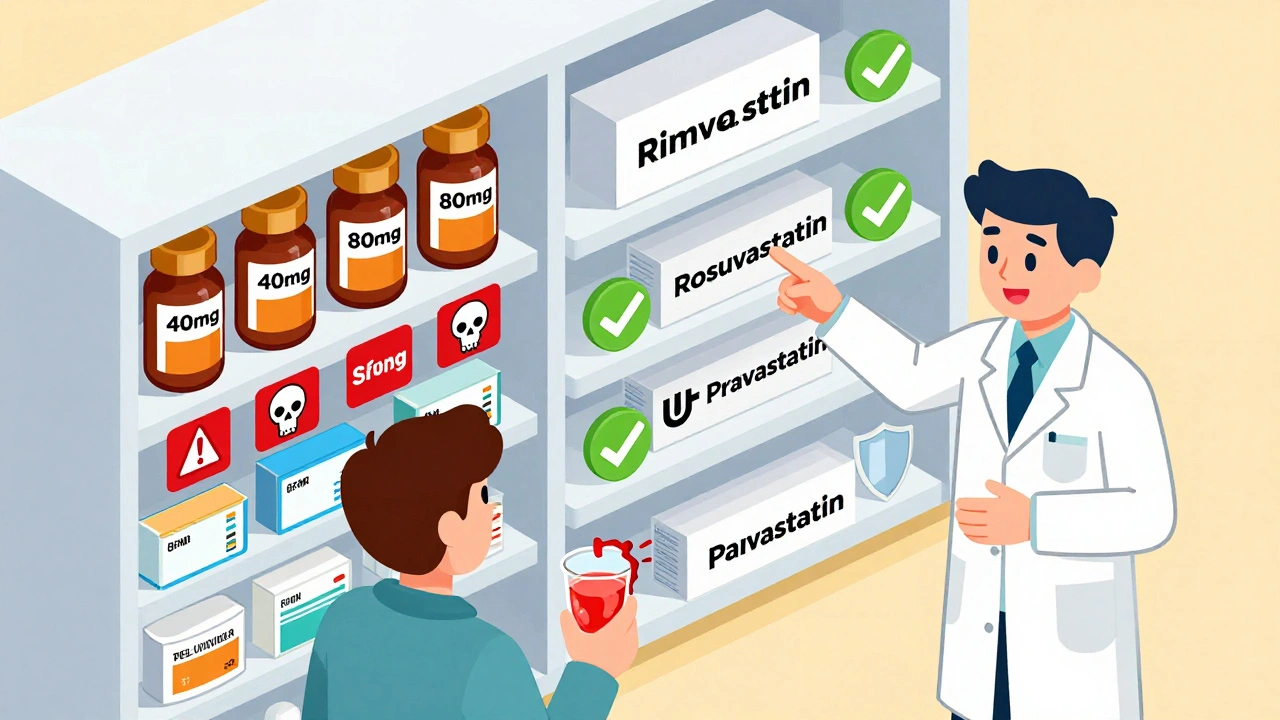
You don’t have to stick with simvastatin if your meds don’t match up. Rosuvastatin (Crestor) and pravastatin (Pravachol) are two statins that don’t rely on CYP3A4. That means they’re much less likely to interact dangerously with other drugs.Even newer options like pitavastatin (Livalo) have fewer interactions and are effective for intensive cholesterol lowering. Yes, they might cost more. But compared to a hospital stay for rhabdomyolysis? The price is worth it.
Doctors are already switching patients off high-dose simvastatin. Between 2011 and 2018, use of the 80 mg dose dropped by 82%. Today, it’s used in fewer than 2% of new prescriptions. That’s not because the drug stopped working. It’s because safer choices exist.
Why This Matters for You
You might think, ‘I’m healthy. I don’t take a lot of meds.’ But here’s the catch: most dangerous interactions happen when you’re prescribed something new - an antibiotic for a sinus infection, a painkiller for back pain, or a new heart medication. You’re not being careless. You’re just not aware.Pharmacists who screen for these interactions reduce dangerous combinations by 67% in older adults. That’s because they catch things doctors miss - like a new prescription for clarithromycin that conflicts with your 40 mg simvastatin.
And it’s not just about drugs. Genetic testing for SLCO1B1 variants can show if you’re at higher risk for muscle damage from simvastatin. People with certain gene versions have up to 4.5 times the risk. If you’ve had unexplained muscle pain on statins before, this test could save your life.
Bottom Line
Simvastatin works. But its risks - especially at high doses - are real, documented, and avoidable. If you’re on 80 mg, talk to your doctor about switching. If you’re on 40 mg and take other meds, review them with your pharmacist. And never, ever drink grapefruit juice while taking it.Cholesterol management is important. But not at the cost of your muscles, your liver, or your life. There are safer, smarter ways to get the same results - without the danger.
Helen Maples
December 7, 2025 AT 22:43Simvastatin at 80 mg is a relic of outdated prescribing habits. The FDA warning wasn’t a suggestion-it was a last call. I’ve seen patients with CKD from rhabdo because their PCP didn’t check interactions. No one should be on 80 mg unless they’re in a controlled trial with weekly CK-MB and creatinine kinase panels. Period.
Pharmacists are the real gatekeepers here. If your pharmacist flags it, listen. Not your doctor who’s rushing between 30 patients an hour.
And grapefruit juice? It’s not just ‘avoid.’ It’s ‘burn the entire tree down.’
Ashley Farmer
December 9, 2025 AT 15:34I appreciate how clearly this was laid out. My mom was on simvastatin 80 mg for years until her pharmacist caught that she was also taking diltiazem. She had mild muscle aches but didn’t think much of it-until the pharmacist said, ‘This could be killing your kidneys.’
She switched to pravastatin, and within two weeks, the pain was gone. No hospital visits. No scary lab results.
Thank you for sharing this. People need to know these things before it’s too late.
Sadie Nastor
December 10, 2025 AT 08:42soooo… like… grapefruit juice is basically the devil for simvastatin? 😅 i thought it was just a myth like ‘don’t mix milk and soda’
also why does everyone say ‘ask your doctor’ like they have time to explain all this? my doc says ‘take this pill’ and leaves. i rely on my pharmacist now. they’re the real MVPs.
switched to rosuvastatin last year. no more muscle cramps. no more panic when i get a cold.
also i’m never touching grapefruit again. not even as a gift. it’s banned in my house.
Nicholas Heer
December 11, 2025 AT 16:51THIS IS A PHARMA COVER-UP. The 80 mg dose was pulled not because it’s dangerous-because it’s TOO EFFECTIVE and they want you on more expensive drugs. Rosuvastatin? Made by AstraZeneca. Same company that pushed Vioxx. Same playbook.
They don’t care if you live or die. They care if you’re on their brand. CYP3A4 isn’t the problem-it’s profit margins.
And don’t get me started on ‘genetic testing.’ That’s just another way to charge you $300 to tell you what you already know: Big Pharma is poisoning you.
My uncle took 80 mg for 12 years. Still alive. Still strong. Still pissed at the system.
Sangram Lavte
December 13, 2025 AT 04:56Very useful post. In India, many patients still get simvastatin 80 mg prescribed because it’s cheap. But the interactions are the same. I’ve seen cases with clarithromycin and simvastatin in our rural clinics. Patients come with severe weakness, dark urine-too late.
Doctors need better training. Pharmacists need more authority. And patients need to speak up.
Switching to pravastatin or rosuvastatin isn’t luxury-it’s basic safety. Even if it costs more, it’s cheaper than ICU.
Stacy here
December 13, 2025 AT 23:04Let’s be real-this isn’t about statins. It’s about control. The medical-industrial complex doesn’t want you to know that a $3 generic can kill you while a $150 brand-name alternative is ‘safer.’
They’ll give you a pamphlet on grapefruit juice but won’t tell you that the CYP3A4 enzyme is suppressed by 90% by common herbs like turmeric and black pepper.
And why is there no public campaign about this? Because the FDA is funded by pharma. Same people who said cigarettes were safe.
This isn’t medicine. It’s corporate ritualism dressed in white coats.
Wesley Phillips
December 15, 2025 AT 20:57Anyone who still takes simvastatin 40 mg+ and drinks grapefruit juice deserves what they get. It’s not rocket science. The label says ‘DO NOT CONSUME GRAPEFRUIT.’
And if you’re on clarithromycin? You’re not a patient-you’re a walking clinical trial.
Also, the 80 mg dose was never meant for routine use. It was for a handful of hypercholesterolemic patients with familial mutations. Now it’s prescribed like Advil.
Blame lazy prescribers. Not the drug.
David Brooks
December 16, 2025 AT 06:07I was on simvastatin 80 mg for 3 years. No symptoms. Felt great. Then I got a sinus infection. Took azithromycin (not clarithromycin, thank god) and woke up one morning unable to lift my arm. My leg felt like concrete.
I went to urgent care. CK level was 28,000. Normal is under 200.
They admitted me. I spent 5 days on IV fluids. Lost 12 pounds of muscle.
I’m now on rosuvastatin 10 mg. No more grapefruit. No more fear.
Don’t wait until your kidneys fail. Listen to this post. Your body will thank you.
Oliver Damon
December 17, 2025 AT 02:01There’s a pharmacokinetic principle here that’s rarely discussed: CYP3A4 inhibition isn’t binary. It’s a gradient. Azithromycin has weak inhibition, clarithromycin is strong, ketoconazole is extreme.
Simvastatin’s AUC increases 5-fold with diltiazem, 10-fold with cyclosporine, and up to 20-fold with ritonavir.
The FDA’s 10 mg cap for diltiazem isn’t arbitrary-it’s based on linear regression of AUC vs. dose-response curves for rhabdomyolysis.
Most clinicians don’t know this. But if you’re reading this, you’re already ahead of 80% of primary care providers.
Knowledge is the only real protective factor here.
Kurt Russell
December 18, 2025 AT 05:00STOP SCROLLING. READ THIS. SAVE YOURSELF.
My cousin died at 47 from rhabdomyolysis. Simvastatin 80 mg + clarithromycin + grapefruit juice. He thought ‘a little juice won’t hurt.’ It did.
He was healthy. Active. Had no idea. No warning. No second chance.
If you’re on simvastatin-check your meds. Talk to your pharmacist. Swap to rosuvastatin. It’s cheaper than a funeral.
Don’t be the next statistic. Your family will thank you.