
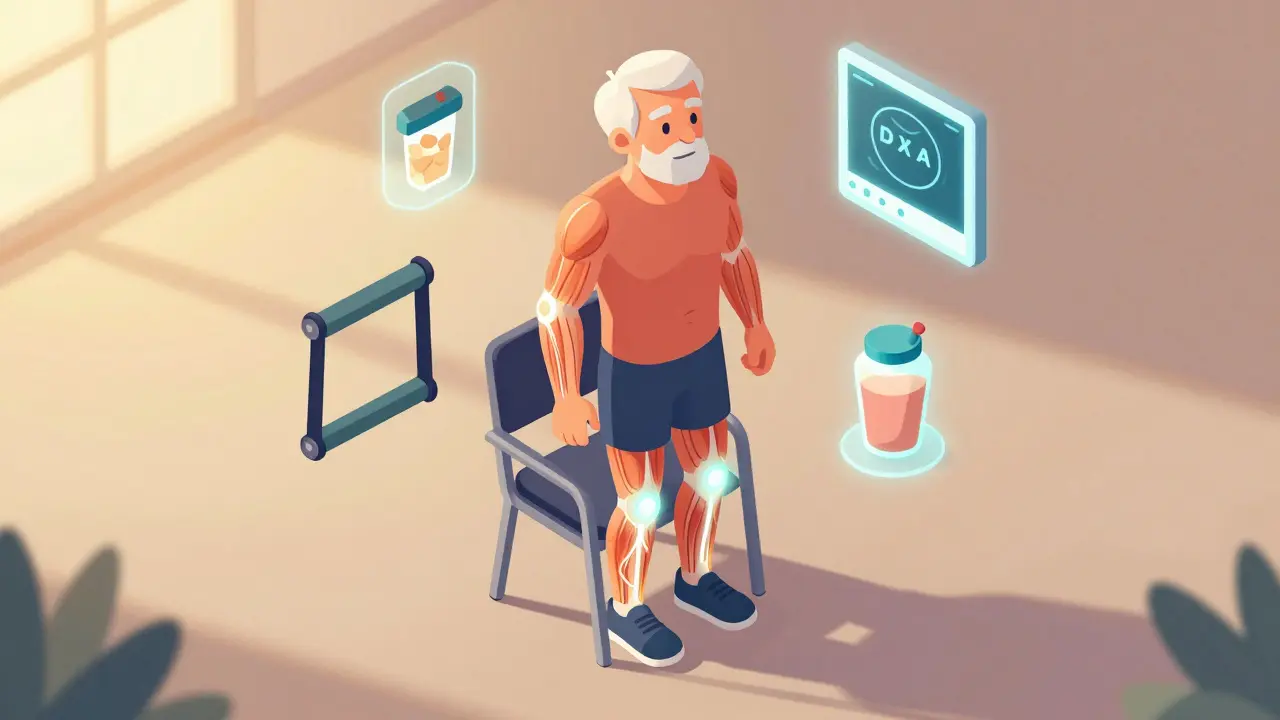
By the time you hit your 40s, your body is already losing muscle-slowly, silently, and without warning. This isn’t just about getting weaker. It’s about losing the ability to stand up from a chair, climb stairs, or carry groceries. This is sarcopenia: the natural, progressive loss of muscle mass and strength that comes with aging. And while it starts in your 30s and 40s, it hits hardest after 65. Left unchecked, it increases your risk of falls, fractures, hospital stays, and even early death. The good news? You can stop it. Or at least slow it down dramatically-with the right kind of strength training.
What Exactly Is Sarcopenia?
Sarcopenia isn’t just feeling a little weaker as you get older. It’s a medical condition defined by the loss of both muscle mass and muscle function. The European Working Group on Sarcopenia in Older People (EWGSOP) set the standard in 2010 and updated it in 2023: you have sarcopenia if you’re losing muscle and your strength or physical performance is dropping. It’s not just about looking thinner-it’s about losing the power to move.
Here’s how it breaks down: After age 30, most people lose 3% to 5% of their muscle mass per decade. After 60, that rate doubles. By age 80, many have lost up to 40% of their muscle. That’s not normal aging-it’s preventable decline. And it’s not rare. About 10% of adults over 60 have sarcopenia. By 80, that number jumps to nearly half.
What’s happening inside your muscles? Your body loses motor neurons-the nerve cells that tell muscles to contract. Fast-twitch muscle fibers (the ones that give you power for quick movements) shrink faster than slow-twitch fibers. Your ability to repair muscle drops by 50-60% by age 70. Your body also becomes less responsive to protein and struggles to make new muscle tissue. Chronic inflammation creeps in, and your mitochondria-the energy factories in your cells-start running on fumes.
How Is Sarcopenia Diagnosed?
Doctors don’t just guess. They measure. The EWGSOP3 guidelines use three key tests:
- Handgrip strength: Less than 27 kg for men or 16 kg for women signals trouble.
- Gait speed: Walking slower than 0.8 meters per second (about 1.8 mph) means your mobility is declining.
- Muscle mass: Measured with a DXA scan (like a bone density test), it checks lean mass in your arms and legs. Below 7.0 kg/m² for men or 5.5 kg/m² for women confirms muscle loss.
These aren’t just numbers. They predict real-life outcomes. People with low grip strength are more likely to fall. Slow walkers are more likely to need help with daily tasks. And those with low muscle mass have higher hospitalization rates.
Sarcopenia vs. Other Muscle Problems
Not all muscle loss is the same. It’s easy to confuse sarcopenia with other conditions:
- General atrophy: This happens when you’re inactive-like after a long hospital stay. You lose muscle fast-up to 1.5% per day. But if you start moving again, you can regain it. Sarcopenia is slower and tied to aging itself.
- Cachexia: This is muscle wasting from serious illness like cancer or heart failure. It comes with weight loss, fatigue, and metabolic chaos. Sarcopenia doesn’t involve systemic illness.
- Dynapenia: This is just strength loss without muscle mass loss. You might still look strong but can’t lift things. Sarcopenia includes both mass and strength loss.
- Sarcopenic obesity: You have low muscle mass and high body fat. This is especially dangerous-it doubles your risk of mobility issues and metabolic disease.
Knowing the difference matters. You can’t treat sarcopenia like you’d treat muscle loss from bed rest. You need a long-term strategy that targets aging biology-not just movement.
Why Strength Training Is the Only Proven Fix
There’s no pill, no supplement, no magic potion that comes close to what strength training does. Decades of research show resistance exercise is the most powerful tool we have to fight sarcopenia.
Johns Hopkins researcher Dr. Jeremy Walston found that older adults who lifted weights for 12 to 16 weeks gained 1 to 2 kg of muscle and boosted strength by 25% to 30%. That’s not small. That’s life-changing. A 72-year-old woman who couldn’t get out of a chair without help started doing seated leg presses twice a week. After 10 weeks, she could stand up unassisted. Another man increased his handgrip strength from 18 kg to 24 kg-enough to open jars again.
Strength training doesn’t just rebuild muscle. It improves nerve-muscle communication, boosts protein synthesis, and reduces inflammation. It makes your mitochondria work better. It helps your body respond to the protein you eat. And it lowers your risk of falls by 30% to 40%.
The American College of Sports Medicine recommends:
- 2 to 3 sessions per week
- 1 to 3 sets of 8 to 12 repetitions
- Weight at 60% to 80% of your one-rep max
- At least 48 hours between sessions for recovery
That’s it. No fancy gear. No extreme workouts. Just consistent, progressive resistance.

How to Start (Even If You’re 70 and Never Lifted a Weight)
You don’t need a gym. You don’t need to bench press. You just need to start moving against resistance.
Here’s a simple plan for beginners:
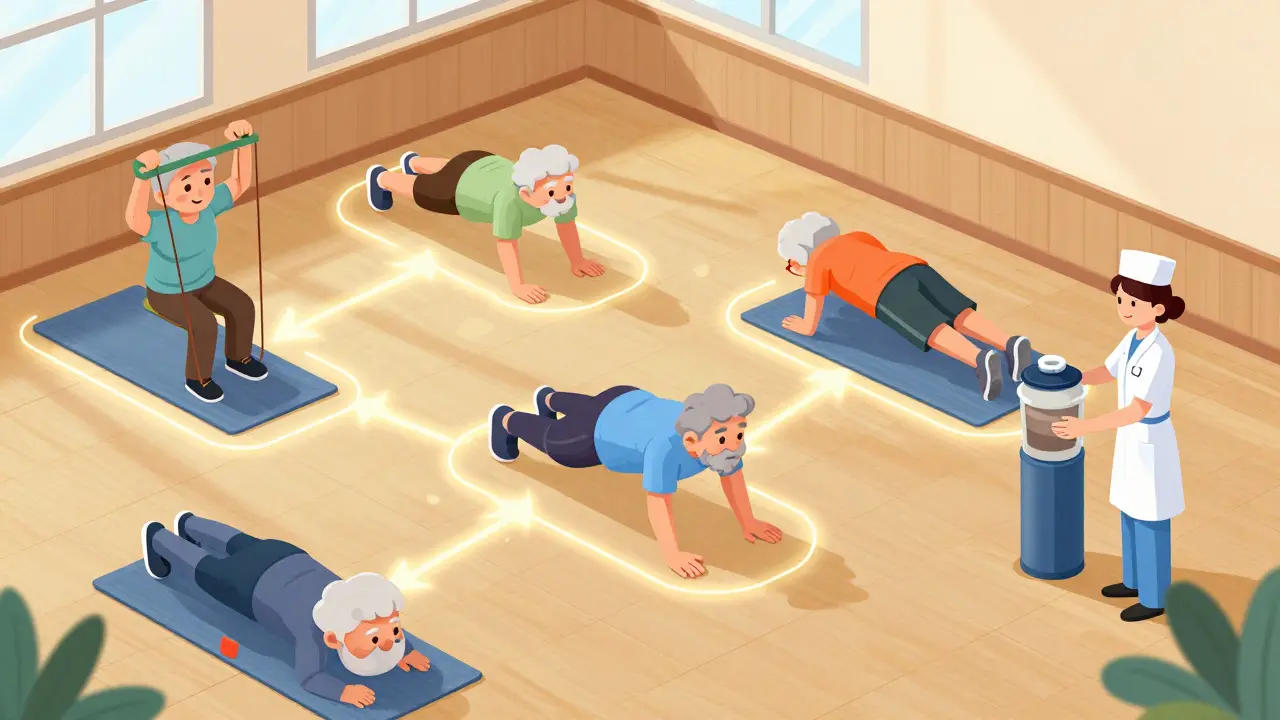
- Weeks 1-4: Bodyweight only-Do chair squats (sit down and stand up slowly), wall push-ups, and seated leg extensions. Do 10 reps, 2 sets, twice a week.
- Weeks 5-8: Add resistance bands-Use light TheraBand (yellow or red). Do banded rows, seated shoulder presses, and band-assisted squats. Keep reps at 10-15.
- Weeks 9-16: Move to machines-Use leg press, chest press, and seated row machines at the gym. Start at 50% of your max, increase weight by 2.5% to 5% every week.
Focus on form over weight. Breathe out when you push or pull. Don’t hold your breath. Rest 60 to 90 seconds between sets. If your joints hurt, switch to seated exercises. If balance is an issue, hold onto a chair or wall.
One of the biggest barriers? Pain. About 35% to 40% of older adults quit because of joint discomfort. The fix? Use machines instead of free weights-they guide your movement. Reduce your range of motion slightly. You don’t need to go full depth on a squat to get results.
The Protein Puzzle
Strength training without enough protein is like building a house without bricks. Your body needs protein to repair and grow muscle. But older adults don’t use protein as efficiently as younger people.
The International Society of Sports Nutrition recommends 20 to 30 grams of high-quality protein within 45 minutes after your workout. Good sources: eggs, Greek yogurt, cottage cheese, chicken, fish, or a whey protein shake. Spread protein evenly across meals-aim for 25-30 grams at breakfast, lunch, and dinner. That’s more effective than loading up at dinner.
Don’t fall for the myth that “I don’t need extra protein because I’m not an athlete.” You’re not trying to get big. You’re trying to stay independent. And that takes more protein than you think.
Real People, Real Results
A 2022 survey of 3,215 older adults by the National Council on Aging found that those who did strength training twice a week were 75% more likely to keep doing daily tasks like bathing, dressing, and cooking without help. Non-exercisers? Only 58% could manage.
On Reddit, a 68-year-old man wrote: “After 6 months of twice-weekly training, I can carry my own laundry up the stairs. I didn’t think that was possible anymore.” A 72-year-old woman in a SilverSneakers program said her fall risk score dropped from 42 to 28 in 10 weeks.
These aren’t outliers. They’re proof that your body doesn’t give up just because you’re older. It just needs the right signal.
Barriers-and How to Overcome Them
Here’s the hard truth: Only 28% of Americans over 65 meet the strength training guidelines. Why?
- Cost: Personal training can run $50-$75/month. Solution: Look for SilverSneakers (covered by many Medicare Advantage plans) or community center classes. Many YMCAs offer senior discounts.
- Confusion: 34% say they don’t know where to start. Solution: Start with YouTube videos from certified trainers like “Fit After 50” or “Senior Strength with Jen.”
- Motivation: Working out alone is hard. Solution: Join a group. People who train with others are 35% to 40% more likely to stick with it.
- Pain: Arthritis or back pain scares people off. Solution: Use machines, seated exercises, or water-based resistance. Pain doesn’t mean you can’t train-it means you need to adapt.
Telehealth programs are also growing. A 2022 JAMA Internal Medicine study found that virtual strength coaching was 85% as effective as in-person sessions. All you need is a phone, a chair, and a resistance band.
The Bigger Picture
Sarcopenia isn’t just a personal health issue-it’s a public health crisis. In the U.S., it costs $18.5 billion a year in healthcare. By 2030, 72 million Americans will be over 65. But there are only 12,500 certified geriatric physical therapists nationwide. We can’t rely on clinics alone.
That’s why prevention is everything. Strength training isn’t a luxury for the fit. It’s a necessity for everyone who wants to live independently. It’s not about looking strong. It’s about being strong enough to live your life.
And the science is clear: the longer you wait, the harder it gets. Starting in your 50s is ideal. But starting at 70? Still works. Starting at 80? Still matters. Muscle doesn’t care how old you are. It only cares if you ask it to grow.
Can sarcopenia be reversed?
Yes, sarcopenia can be significantly reversed-even in people over 80. Studies show that with consistent strength training and adequate protein intake, older adults can gain 1 to 2 kilograms of muscle and improve strength by 25% to 30% within 12 to 16 weeks. While you may not regain the muscle you had at 30, you can restore enough function to live independently and reduce fall risk dramatically.
Is walking enough to prevent sarcopenia?
Walking is great for heart health and endurance, but it’s not enough to prevent or reverse sarcopenia. Walking doesn’t challenge your muscles enough to stimulate growth. You need resistance-lifting, pushing, or pulling against weight-to rebuild muscle. Combine walking with strength training for the best results.
How often should seniors lift weights?
Seniors should aim for 2 to 3 strength training sessions per week, with at least 48 hours of rest between sessions for the same muscle groups. Two days is the minimum for noticeable benefit. Three days is ideal for maximum gains. Start light, focus on form, and increase weight slowly-no more than 5% per week.
Do I need a gym membership to fight sarcopenia?
No. You can do effective strength training at home with just a chair, resistance bands, and your body weight. Exercises like seated leg lifts, wall push-ups, and band rows build strength without equipment. Many community centers, YMCAs, and Medicare Advantage plans offer free or low-cost senior fitness programs that include strength training.
Can protein supplements help with sarcopenia?
Yes, but only as a supplement to food-not a replacement. Getting 20 to 30 grams of high-quality protein after exercise helps muscle repair. Whey protein, eggs, Greek yogurt, and lean meats are best. Supplements can help if you struggle to eat enough protein, but whole foods provide additional nutrients your muscles need. Don’t rely on shakes alone.
What if I have arthritis or joint pain?
Joint pain doesn’t mean you can’t train-it means you need to adapt. Use machines instead of free weights to control movement. Try seated exercises. Reduce your range of motion slightly-partial squats still build strength. Water-based resistance or cycling with light resistance can also help. Always consult a physical therapist to design a safe plan for your condition.
Next Steps: What to Do Today
Don’t wait for a diagnosis. Don’t wait until you can’t get up from a chair. Start now.
- Look up SilverSneakers if you have Medicare Advantage-it’s free access to gyms and classes.
- Download a free senior strength video from YouTube (search “beginner strength training over 70”).
- Buy a set of resistance bands for under $20.
- Plan two days a week to move against resistance-no excuses.
- Include 20-30 grams of protein at your next meal after training.
Your future self will thank you-not for looking good, but for being able to live life on your own terms.
Ashley S
January 7, 2026 AT 04:28Rachel Wermager
January 7, 2026 AT 22:48Lily Lilyy
January 8, 2026 AT 04:37And yes - it’s okay to start slow. Baby steps. One rep at a time. You’re already winning by reading this.
Susan Arlene
January 8, 2026 AT 05:02Brian Anaz
January 9, 2026 AT 08:50Vinayak Naik
January 9, 2026 AT 12:35Saylor Frye
January 11, 2026 AT 00:02Molly McLane
January 11, 2026 AT 12:23It’s not about how heavy the weight is. It’s about showing up. Even once a week. Even if you only do 3 reps. You’re still winning. And if you need help? Ask. We’re here. No shame. No judgment. Just progress.