
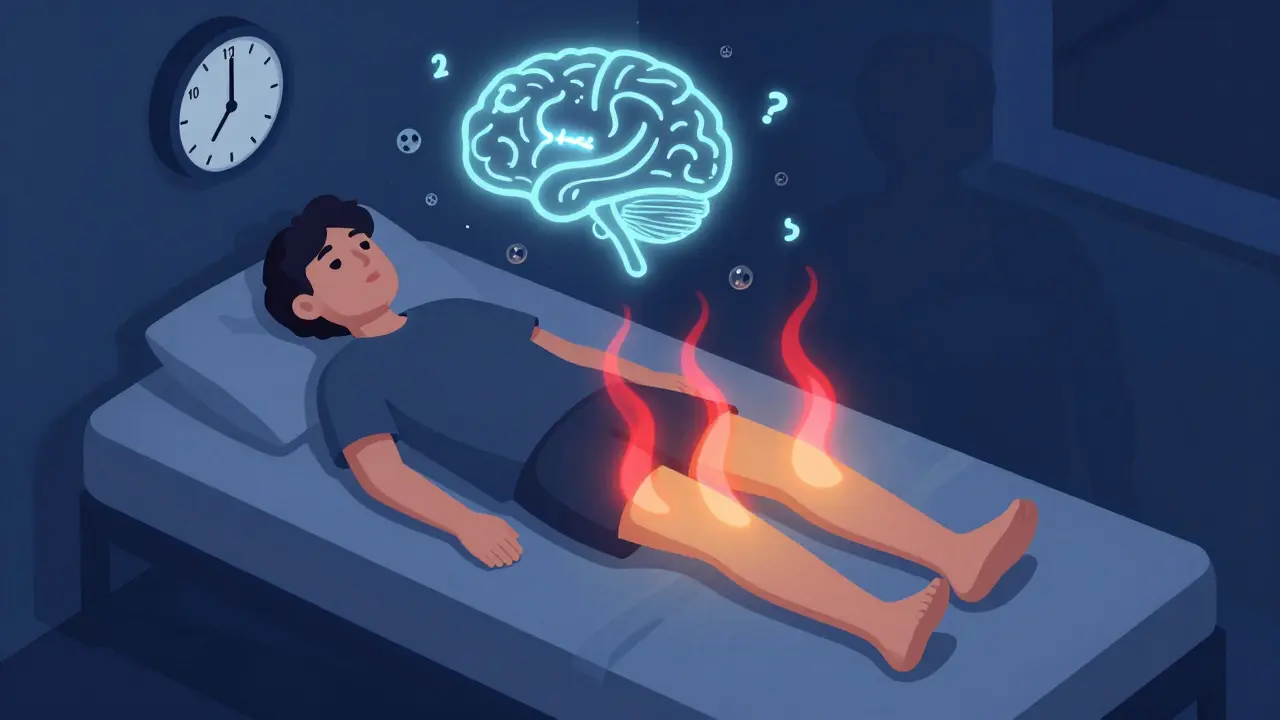
Imagine lying in bed, legs heavy and tingling, but every time you try to sleep, an unbearable urge to move takes over. You get up, pace the floor, stretch your legs - and for a moment, it’s better. Then, as soon as you lie down again, it comes back. This isn’t just restlessness. It’s restless legs syndrome (RLS), a neurological condition that steals sleep from millions of people - often without them even knowing why.
RLS, also known as Willis-Ekbom disease, affects about 10% of U.S. adults. For many, it starts subtly: a creeping feeling in the calves, an itch that can’t be scratched, a twitch that won’t stop. But by midnight, it’s worse. Symptoms peak between 8 p.m. and midnight, making sleep nearly impossible. Polysomnography studies show people with RLS lose 30-50% of their total sleep time. They spend more time in light sleep (N1 and N2 stages) and less in deep, restorative sleep. The result? Constant fatigue, trouble focusing, and a higher risk of car accidents - up to 2.3 times more likely than in people without RLS.
Why Your Legs Won’t Stop Moving
The root cause isn’t stress, poor circulation, or laziness. It’s biology. Brain imaging shows RLS patients have 20-30% less dopamine transporter activity in the striatum, the area of the brain that controls movement and reward. This isn’t just low dopamine - it’s a broken delivery system. Dopamine signals from the A11 neurons in the midbrain fail to reach the spinal cord properly, leaving the legs in a state of constant, confusing alertness.
Iron plays a role too. Low iron in the substantia nigra - the same brain region affected in Parkinson’s - worsens dopamine dysfunction. About half of RLS patients have ferritin levels below 75 ng/mL, even if their blood iron looks normal. That’s why iron supplements aren’t just a side note - they’re part of the treatment for many.
And it’s not just the legs. Around 80-90% of RLS patients also have periodic limb movement disorder (PLMD), where legs jerk every 20-40 seconds during sleep. These movements aren’t voluntary. They’re automatic, and they fragment sleep into dozens of tiny awakenings - each too brief to remember, but enough to keep you exhausted all day.
How Dopaminergic Therapy Works - and Why It’s a Double-Edged Sword
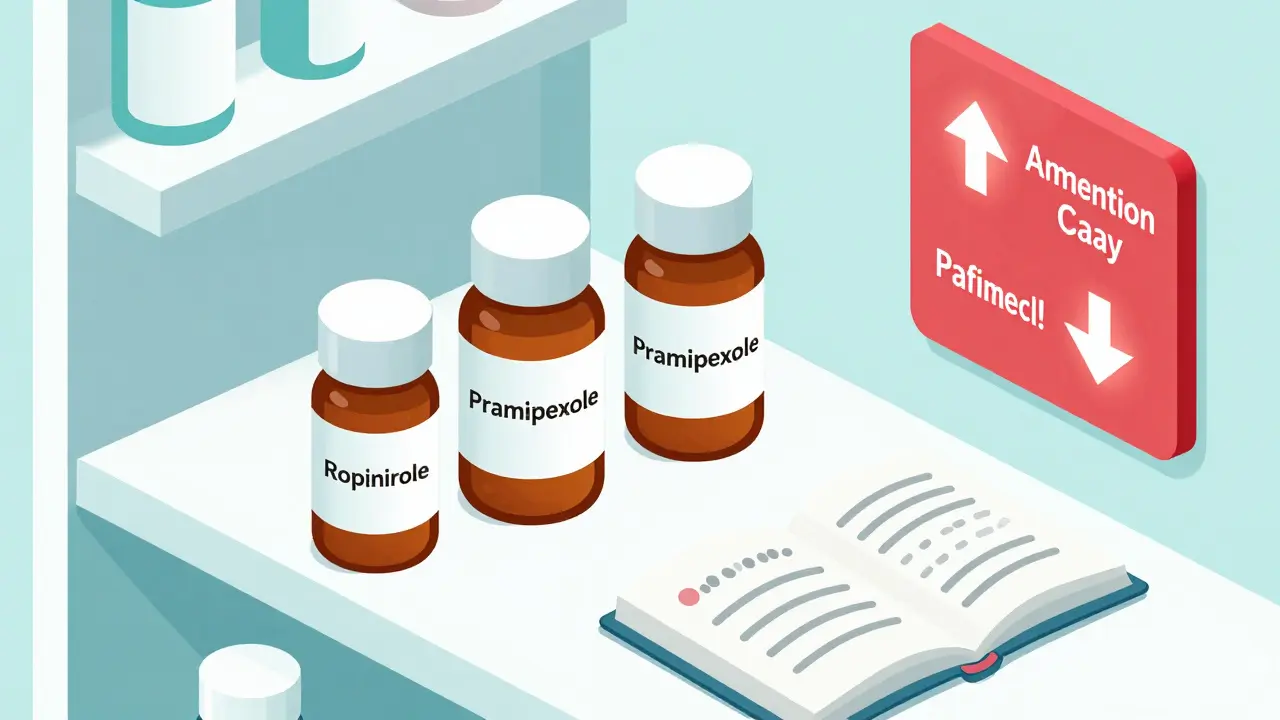
For decades, the go-to treatment for moderate to severe RLS has been dopamine agonists. These drugs mimic dopamine in the brain, tricking the system into calming down. Three FDA-approved options exist: ropinirole (Requip), pramipexole (Mirapex), and rotigotine (Neupro patch).
They work fast. Most people feel relief within an hour. In clinical trials, ropinirole at 4 mg daily cut RLS symptoms by 47% - nearly double the placebo effect. Pramipexole and rotigotine show similar results. For someone who’s spent years unable to sleep, this is life-changing.
But here’s the catch: long-term use can make things worse.
Augmentation is the biggest risk. It means symptoms start earlier in the day - maybe at noon instead of midnight. They spread to the arms. They get more intense. And the dose that once helped now feels like it’s not enough. Studies show 20-70% of patients develop augmentation after one year. Pramipexole has the highest rate - up to 66% after three years. Rotigotine, the patch, is better, with only 26% augmentation over the same period.
There’s another hidden cost: impulse control disorders. About 6-17% of patients develop compulsive behaviors - gambling, shopping, eating, even hypersexuality. One patient on Reddit described racking up $20,000 in credit card debt from uncontrollable online shopping. The FDA requires black box warnings on all dopamine agonists for this reason.
Alternatives That Work Without the Risk
Not everyone needs dopamine drugs. For many, better options exist - especially if symptoms are daily, not just occasional.
Alpha-2-delta ligands like gabapentin enacarbil and pregabalin have become first-line choices for chronic RLS. They don’t touch dopamine. Instead, they calm overactive nerve signals. In a 2021 head-to-head trial, pregabalin (300 mg nightly) matched pramipexole in symptom relief - but with only 8% augmentation versus 32%. That’s a huge difference.
And while dopamine agonists kick in fast, these drugs take 2-4 weeks to work. That’s a trade-off. But for patients who’ve been burned by augmentation, it’s worth the wait.
Iron therapy is another powerful tool - if you’re deficient. Intravenous ferric carboxymaltose can improve symptoms by 30-40% in patients with ferritin below 75 ng/mL. It’s not instant. It takes 3-6 months. But for those who respond, it’s life-changing - and it doesn’t carry the risks of dopamine drugs.
What Experts Recommend Today
The International Restless Legs Syndrome Study Group (IRLSSG) updated its guidelines in 2022. Here’s what they say:
- Start with non-drug fixes: improve sleep hygiene, avoid caffeine and alcohol, try moderate exercise (like walking or yoga) in the afternoon.
- Check your iron. If ferritin is below 75 ng/mL, supplement - orally or via IV.
- For intermittent symptoms (2-3 nights a week), dopamine agonists are still fine.
- For daily symptoms, start with pregabalin or gabapentin enacarbil. Save dopamine drugs for when those don’t work.
Dr. Richard Allen, a leading RLS researcher, put it plainly: “Dopaminergic therapy remains essential for severe RLS, but dose escalation often backfires.”
And it’s not just experts. Real patients are switching. A review of over 1,200 patient stories found that 65% of long-term dopamine users eventually moved to alpha-2-delta drugs because of augmentation. Pregabalin was the top replacement.
Managing Treatment - What You Need to Track
If you’re on dopamine therapy, don’t wait for symptoms to explode before acting. Use a simple symptom diary:
- When do symptoms start? (Time of day)
- How bad are they? (Rate 0-10)
- Do they spread to arms or other body parts?
- Do you feel the urge to move even when you’re not resting?
A 2022 study found that 83% of augmentation cases were caught within 3 months using this method. Early detection means you can switch drugs before things spiral.
Also, never increase your dose on your own. The maximum recommended doses are there for a reason: ropinirole at 4 mg, pramipexole at 0.5 mg. Going higher doesn’t help - it just raises the risk of augmentation and impulse disorders.
What’s Next for RLS Treatment?
New options are coming. In 2023, an extended-release version of ropinirole (Requip XL) got approved. It releases the drug slowly, keeping levels steady. Early data shows 18% augmentation at 12 months - better than the 31% seen with the old version.
Other drugs in trials include fipamezole (an alpha-2 adrenergic antagonist) and intranasal apomorphine, which delivers dopamine directly to the brain without flooding the system. These could mean fewer side effects and less augmentation.
Genetics may soon guide treatment. Researchers have linked RLS to two gene variants - BTBD9 and MEIS1. In a 2022 study, genetic testing predicted pramipexole response with 72% accuracy. Imagine knowing before you start whether a drug will help - or hurt.
The market is shifting too. Dopamine agonists still make up 55% of RLS sales, but the fastest-growing segment is alpha-2-delta ligands. By 2027, the global RLS treatment market is expected to hit $1.8 billion - driven not by stronger dopamine drugs, but by safer alternatives.
Bottom Line: What You Should Do
If you have RLS:
- Don’t accept poor sleep as normal. Talk to a sleep specialist.
- Get your ferritin level checked. If it’s below 75 ng/mL, iron therapy could help.
- If symptoms are daily, ask about pregabalin or gabapentin enacarbil first.
- If you’re on a dopamine agonist and your symptoms are getting worse or spreading - stop increasing the dose. Talk to your doctor.
- Keep a symptom log. It’s the best early warning system for augmentation.
RLS doesn’t have to control your life. The right treatment - whether it’s iron, a nerve-calming drug, or carefully managed dopamine therapy - can restore your sleep. But only if you know the risks - and the alternatives.
What triggers restless legs syndrome?
Triggers include prolonged sitting or lying down, especially in the evening. Caffeine, alcohol, and certain medications like antihistamines can worsen symptoms. Low iron levels in the brain and genetic factors also play a major role. For many, symptoms are worse during periods of inactivity and improve with movement.
Can restless legs syndrome be cured?
There is no known cure for RLS, but symptoms can be effectively managed. For some, iron supplementation or lifestyle changes are enough. For others, medications like alpha-2-delta ligands or dopamine agonists provide strong relief. In cases linked to underlying conditions like kidney disease or pregnancy, treating the root cause can eliminate RLS.
How do dopamine agonists like ropinirole and pramipexole work?
These drugs activate dopamine receptors in the brain, particularly the D3 subtype, which helps calm abnormal nerve signals in the spinal cord that cause the urge to move. They’re taken 1-3 hours before bedtime to match the peak timing of RLS symptoms. While effective, they don’t fix the underlying dopamine or iron dysfunction - they mask it, which can lead to long-term complications like augmentation.
What is augmentation, and how can I spot it?
Augmentation is when RLS symptoms worsen due to long-term dopamine therapy. Signs include symptoms starting earlier in the day (like mid-afternoon), spreading to other body parts (arms, torso), increasing in intensity, or requiring higher doses. If your symptoms change in timing or location after months of treatment, talk to your doctor - it’s likely augmentation.
Are there natural ways to manage RLS?
Yes. Maintaining good sleep hygiene - consistent bedtime, cool room, no screens before bed - helps. Regular moderate exercise, especially in the afternoon, can reduce symptoms. Avoiding caffeine, nicotine, and alcohol is critical. Iron supplements may help if your ferritin is low. Some people report relief from leg massages, warm baths, or compression devices, though evidence is limited.
Why is pregabalin becoming a first-line treatment for RLS?
Pregabalin offers symptom relief comparable to dopamine agonists but with far lower risk of augmentation (8% vs. 32% at 6 months). It doesn’t affect dopamine, so it doesn’t trigger the same long-term brain adaptations. It’s especially useful for patients with daily symptoms who need ongoing treatment without the risk of worsening symptoms over time.
How long does it take for iron therapy to work in RLS?
Oral iron supplements can take 3-6 months to show improvement, especially if ferritin is very low. Intravenous iron (like ferric carboxymaltose) works faster - some patients notice changes in 4-8 weeks. Maximum benefit typically occurs after 3-6 months. It’s not a quick fix, but for those with iron deficiency, it can be transformative.
Is restless legs syndrome genetic?
Yes. About 50-60% of RLS cases have a family history. Two gene variants - BTBD9 and MEIS1 - are strongly linked to the condition. These genes affect how the brain processes iron and dopamine. Genetic testing isn’t routine yet, but research shows it can predict who’s more likely to respond to certain drugs or develop augmentation.
Dylan Patrick
March 13, 2026 AT 04:08Been dealing with RLS for 8 years. Started on pramipexole. Thought it was magic until my arms started twitching at 3 p.m. Augmentation hit hard. Switched to pregabalin. Took 3 weeks to kick in, but now I actually sleep. No gambling urges, no debt, no panic when I sit down. Worth the wait.
Elsa Rodriguez
March 14, 2026 AT 23:51I used to think it was just stress. Then I started losing sleep every night. My husband had to sleep on the couch because I’d pace like a caged tiger. When I found out it was neurological? I cried. Then I Googled everything. Now I take iron and gabapentin. No dopamine drugs. Ever again.
tynece roberts
March 16, 2026 AT 19:46so i tried the iron thing for 4 months and nothing? like zero? then my doc was like 'wait ur ferritin is 28' and i was like 'wait what?' turns out my body just refuses to absorb it. got iv iron. 3 weeks later? i slept 7 hours straight for the first time in 5 years. mind blown. 🤯
Kathy Leslie
March 17, 2026 AT 23:48I’m so glad this post exists. I’ve been too scared to talk to my doctor about this because I thought I was just ‘anxious’ or ‘not sleeping right.’ Turns out, I’m not broken. Just low iron and overstimulated nerves. Pregabalin changed my life. I can finally hug my kids without my legs screaming at me.
Stephanie Paluch
March 18, 2026 AT 03:19Iron + yoga + no caffeine = my new holy trinity. 🙏 I used to think I was lazy. Turns out I had a neurological disorder. My doc didn’t even mention ferritin until I brought it up. Don’t wait. Get tested. Even if your blood iron looks fine. Brain iron is a whole other beast.
Alex MC
March 19, 2026 AT 11:23As someone who’s been through this, I appreciate the clarity. Dopamine agonists are tempting, but they’re not a cure. They’re a band-aid with side effects. Pregabalin isn’t flashy, but it’s sustainable. I’ve been on it for 4 years. No augmentation. No drama. Just sleep. 🌙
Buddy Nataatmadja
March 21, 2026 AT 06:11Living in Jakarta, I noticed RLS was way more common than I thought. Local doctors here still treat it like ‘nervous energy.’ But once I explained the dopamine-iron link? They got it. Now I help others here find proper testing. Knowledge matters.
Serena Petrie
March 22, 2026 AT 07:45Just took pregabalin. First night. Slept 5 hours. Not bad. Still twitchy. Waiting to see if it gets better.
Aaron Leib
March 24, 2026 AT 00:50For those new to this: your doctor isn’t ignoring you. They’re just trained to think of RLS as a nuisance, not a disease. Push for ferritin. Push for sleep studies. You deserve better than ‘take a warm bath and chill.’
rakesh sabharwal
March 24, 2026 AT 14:30It’s fascinating how the neurochemical cascade in RLS mirrors early-stage Parkinsonian dysfunction, yet we persist in treating it with dopaminergic agonists as if it were a simple neurotransmitter deficiency. The pharmacokinetic inefficacy of oral agents in crossing the blood-brain barrier further compounds the issue, necessitating a paradigm shift toward targeted neuromodulation.
mir yasir
March 24, 2026 AT 20:33While the article presents a scientifically sound overview, it fails to address the socioeconomic disparity in access to IV iron and pregabalin. In many regions, these are unaffordable. The real solution isn’t pharmacology - it’s healthcare equity.
Amisha Patel
March 25, 2026 AT 05:42My mom has RLS. She tried everything. Finally, after 6 months of oral iron, her symptoms dropped by 70%. She still walks around at night, but now she can sit still long enough to watch TV. I’m just glad we found something that works.
Hugh Breen
March 25, 2026 AT 17:30OMG I just realized I’ve had this my whole life. I thought I was just ‘restless.’ Now I get why I can’t sit through movies. I’m getting my ferritin checked tomorrow. And I’m ditching wine. No more excuses. 🙌
Lorna Brown
March 27, 2026 AT 10:16If RLS is tied to BTBD9 and MEIS1 genes, and dopamine agonists worsen the underlying pathology - isn’t this a case of treating symptoms while accelerating disease progression? We’re not just masking - we’re potentially accelerating neurodegeneration. Shouldn’t we be prioritizing gene-targeted therapies over symptomatic relief?
Byron Boror
March 28, 2026 AT 06:20Why are we letting Big Pharma push these expensive drugs? Iron is dirt cheap. Pregabalin’s generic. But they want you on dopamine agonists because they make billions. Wake up. This isn’t science - it’s profit.