
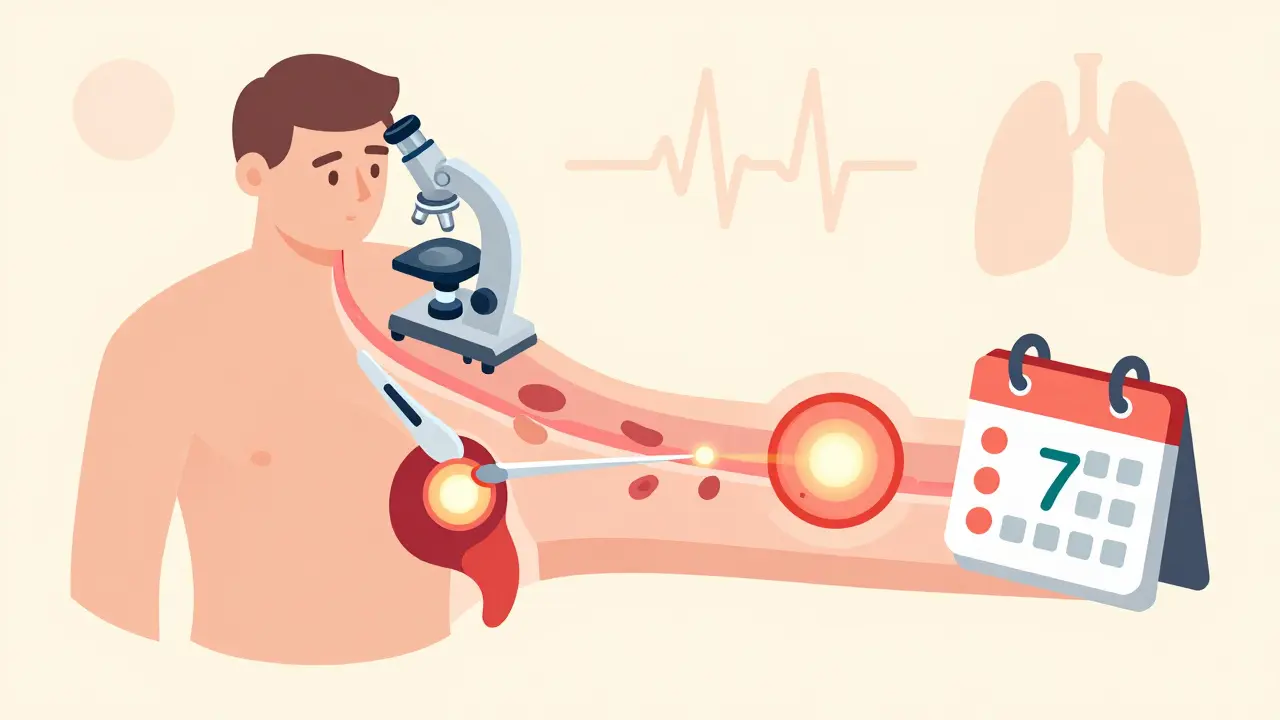
When you're diagnosed with localized cancer-whether it's in your prostate, lung, or another organ-you're often faced with a tough question: radiation or surgery? Both aim to remove or destroy the tumor before it spreads, but they work in very different ways. Neither is universally better. The right choice depends on your cancer type, your health, and what matters most to you in daily life.
What Local Control Really Means
Local control means stopping cancer where it started. It doesn’t guarantee you’ll never have cancer again, but it stops the tumor from growing in its original spot. For many people, this is enough. Prostate and lung cancers are the most common examples where local control is the first goal. Together, they make up nearly 30% of all new cancer cases in the U.S. each year.Both radiation and surgery are considered standard treatments. But they’re not interchangeable. One removes the tumor physically. The other uses targeted energy to kill cancer cells over time. Understanding how each works helps you ask the right questions.
How Surgery Works: Cutting It Out
Surgery means removing the tumor and some surrounding tissue. For prostate cancer, that’s a radical prostatectomy. For lung cancer, it’s often removing a lobe of the lung. The goal is to get it all out in one go. Pathologists then examine the tissue under a microscope to confirm exactly how much cancer was there-and whether it’s likely to come back.For prostate cancer, surgery is done through open, laparoscopic, or robotic methods. The procedure takes 2-4 hours. Most people stay in the hospital 1-3 days. Recovery is intense for the first few weeks, but it’s over quickly. No daily trips. No ongoing treatment schedule.
For lung cancer, surgery is more complex. A lobectomy (removing one lobe of the lung) can be done with small incisions using a camera (VATS) or robot, or through a large chest cut (thoracotomy). Hospital stays are longer-3 to 7 days. Full recovery takes 6-8 weeks. You’ll need help with breathing exercises and physical activity during that time.
The big advantage? You get a clear picture of what was inside. No guesswork. If the margins are clean-no cancer cells at the edges-you’re in a strong position. But surgery isn’t for everyone. If you have heart disease, COPD, or other serious health issues, the risks of anesthesia and major surgery might outweigh the benefits.
How Radiation Works: Targeting Without Cutting
Radiation therapy uses high-energy beams-usually X-rays or protons-to destroy cancer cells. Modern machines can target tumors within 1-2 millimeters. That’s like hitting a marble from 100 yards away without touching anything else.For prostate cancer, traditional radiation means daily sessions, 5 days a week, for 7-9 weeks. Each session is 15-30 minutes. You walk in, lie on a table, get treated, and leave. No anesthesia. No incisions. But it’s a long haul. Missing a day means extending the whole course. If you live far from a treatment center, this becomes a major burden.
For early-stage lung cancer, there’s a faster option: stereotactic body radiation therapy (SBRT). Instead of 40 sessions, you get 1-5. Each one is more powerful. You might do it over one week. No hospital stay. Most people return to normal activities the next day.
Modern radiation isn’t what people think. It doesn’t make you radioactive. You won’t glow in the dark. The beams are precisely shaped to match your tumor’s shape, using real-time imaging. Your body changes slightly each day-breathing, weight shifts-so the machine adjusts. It’s not blunt force. It’s precision.
Effectiveness: What the Data Really Shows
You’ll hear conflicting claims. Some say surgery is better. Others say radiation is just as good. The truth? It depends on the cancer and your risk level.For prostate cancer, the landmark ProtecT trial followed 1,643 men for 10 years. Those treated with surgery, radiation, or active monitoring had nearly identical survival rates: 96.8%, 95.7%, and 95.8% respectively. But disease progression was more common in the monitoring group (24.7%) than in either treatment group (around 13%).
But here’s the catch: ProtecT mostly included low-risk patients. A separate study of 91,000 men by UCSF found something different. For high-risk prostate cancer, surgery led to a 62% 15-year survival rate. Radiation? Only 52%. That’s a 10-point gap. Why? Because radiation alone sometimes doesn’t fully kill aggressive cancer cells. That’s why high-risk patients often get radiation plus hormone therapy.
For lung cancer, the numbers are clearer. A 2022 analysis of over 30,000 patients found that those who had surgery had a 71.4% five-year survival rate. Those who got SBRT had 55.9%. That’s a big difference. But here’s the key: SBRT was given to patients who were either too sick for surgery or refused it. When you compare only patients who were healthy enough for both, surgery still wins. But for someone who can’t have surgery, SBRT offers a real chance-40-50% five-year survival, which is far better than no treatment.
Side Effects: What You’ll Live With
This is where the real trade-offs show up. You might survive cancer, but what kind of life do you want after?For prostate cancer, surgery often causes urinary leakage and erectile dysfunction. The NIH study of 1,692 men found that 14% of surgical patients had urinary leakage 10 years later. For radiation? Only 4%. But radiation has its own problems: 8% of radiation patients had serious bowel issues after 10 years. Surgery? Just 3%.
For high-risk patients, the pattern flips. Surgery leads to 25% urinary leakage after a decade. Radiation? 11%. But radiation combined with hormone therapy increases bowel problems to 7%. That’s because hormones can make the rectum more sensitive to radiation damage.
The ProtecT trial found that at six months, urinary and sexual side effects were 2.5 times worse after surgery. By five years, the gap narrowed. Bowel problems from radiation stayed higher. So if you’re young and want to keep your sexual function, radiation might be easier. If you’re older and worried about bowel control, surgery might be better.
For lung cancer, surgery means losing part of your lung. You’ll be winded more easily, especially climbing stairs or walking uphill. But most people adapt. Radiation doesn’t remove tissue, so breathing capacity stays closer to normal. But some patients develop lung scarring (fibrosis) over time, which can cause shortness of breath years later.
Logistics and Life Impact
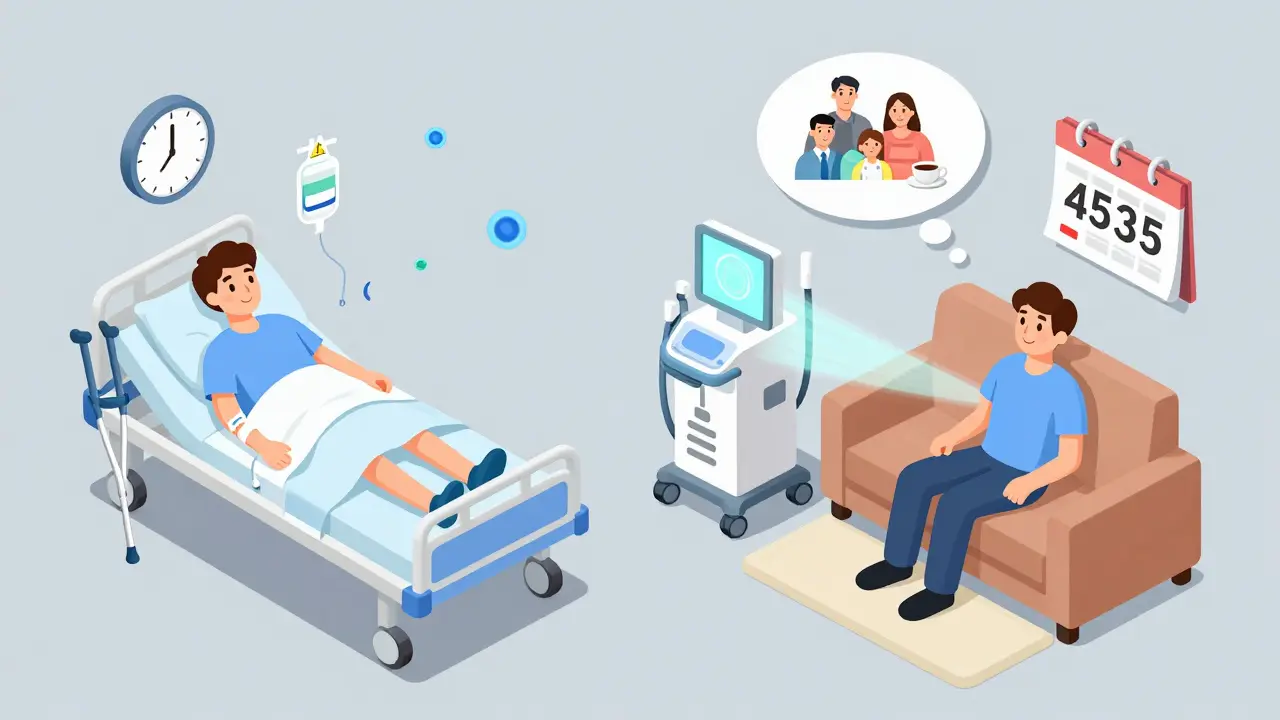
Surgery is a one-time event. You recover. Then it’s done.Radiation is a commitment. For prostate cancer, that’s 35-45 visits over two months. If you work, you’ll need to take time off. If you live 2 hours from the clinic, you’ll be driving back and forth every weekday. That’s exhausting. Insurance doesn’t always cover travel. Family support becomes essential.
SBRT for lung cancer is different. Five visits. One week. No hospital stay. You might not even miss work. That’s why many patients choose it-even if surgery is an option. It’s less disruptive. Less stress. Less time away from family.
But here’s the thing: radiation doesn’t always work the first time. If the cancer comes back in the same spot, you can’t usually do radiation again. Surgery might be an option then, but it’s harder. With surgery, if cancer returns, radiation might still be possible.
What Experts Say
Dr. Matthew Cooperberg, who led the UCSF study, says: “There’s relatively little high-quality evidence on which to base current treatments.” He’s not saying one is better. He’s saying we need to talk more about individual needs.Dr. Christopher King at Cedars-Sinai says: “Talk with a surgeon and a radiation oncologist before you make your decision.” He’s not pushing one option. He’s pushing two opinions.
The American Society of Clinical Oncology says it plainly: all patients with localized prostate cancer should have access to both urologic and radiation oncology consultations. That’s not a suggestion. It’s the standard.
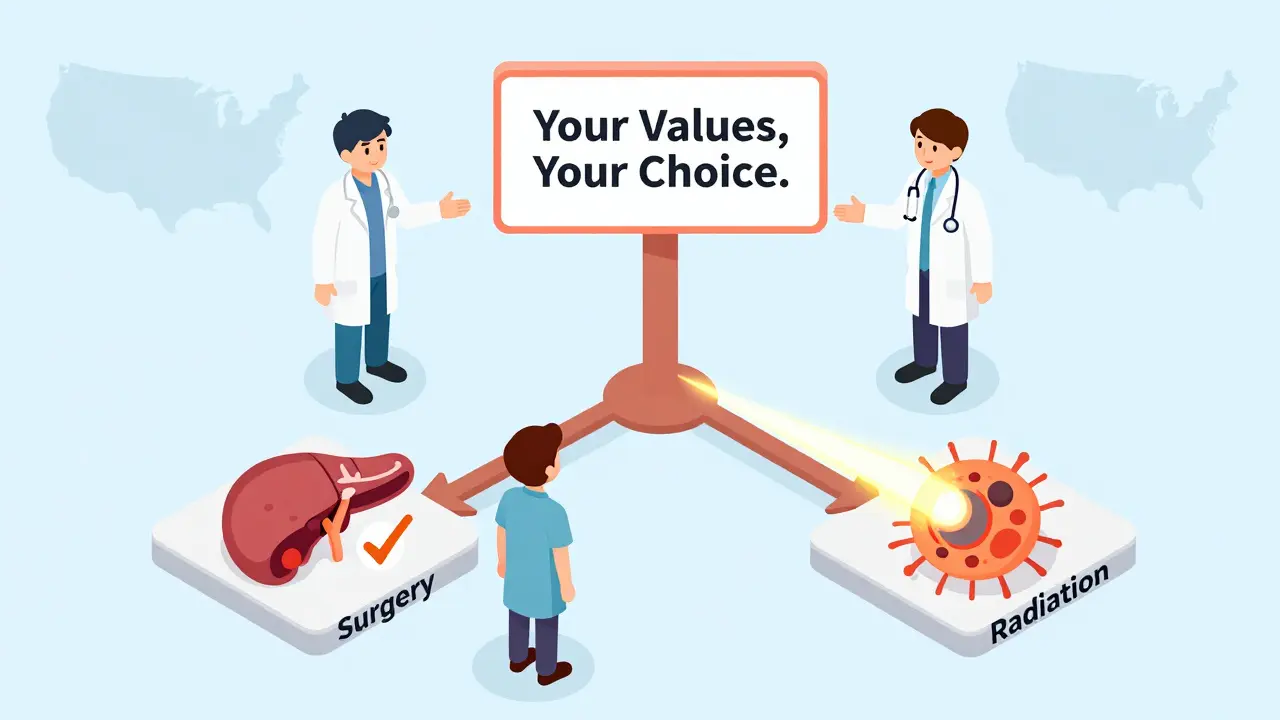
At Mayo Clinic, they use a simple rule: treatment should match your cancer, your health, and your values. If you hate the idea of being tied to a clinic for months, surgery might suit you. If you’re afraid of cutting into your body, radiation might feel safer. Neither is wrong.
What’s Next? New Options on the Horizon
Focal therapy for prostate cancer is being tested right now. Instead of treating the whole gland, it targets only the tumor. Think of it like a laser spot-removal for cancer. The PARTICLE trial, which started in 2019, is comparing this to standard treatments. Results are expected in 2025.Proton beam therapy is another emerging option. It delivers radiation with even more precision, reducing damage to nearby organs. It’s expensive and not widely available, but for some patients-especially children or those with tumors near critical structures-it’s changing the game.
These aren’t replacements yet. But they show the field is moving toward more personalized, less invasive options.
Your Next Steps
If you’re facing this decision:- Get both consultations. Don’t pick based on one opinion.
- Ask for your risk group. Is it low, intermediate, or high? That changes everything.
- Map out your life. Can you commit to 9 weeks of daily trips? Do you have help at home for recovery?
- Think about what you can’t live without. Urinary control? Sexual function? Breathing? Prioritize.
- Use tools like the Prostate Cancer Foundation’s decision tool. It’s built on data from over 129,000 patients.
There’s no perfect choice. But there is a right one-for you. Not for the person next to you. Not for the doctor’s favorite. For you.
Is radiation therapy safer than surgery?
It depends on what you mean by "safer." Surgery carries risks from anesthesia and major incisions, which can be dangerous for people with heart or lung problems. Radiation avoids those risks but can cause long-term damage to nearby organs like the bladder or rectum. Neither is universally safer. The safer option is the one that fits your health profile.
Can I switch from radiation to surgery if radiation doesn’t work?
It’s possible, but much harder. Radiation damages tissue, making surgery more complicated and risky. If you choose radiation first, you lose the option for a clean surgical removal later. That’s why experts recommend getting both opinions before starting treatment.
Why do some studies say surgery is better and others say they’re equal?
Because the patients are different. The ProtecT trial mostly included low-risk prostate cancer patients, where both treatments work well. The UCSF study looked at high-risk patients, where surgery showed better long-term survival. The cancer’s aggressiveness changes everything. Always ask: "Which group am I in?"
Does radiation cause cancer elsewhere in the body?
The risk is extremely low. Modern radiation is focused tightly on the tumor. The chance of causing a second cancer from treatment is less than 1% over 20 years. That’s far lower than the risk of the original cancer spreading if untreated. The benefit of local control far outweighs this tiny risk.
How do I know if I’m a candidate for SBRT instead of surgery for lung cancer?
SBRT is usually offered if you’re medically inoperable-meaning you have heart disease, COPD, or other conditions that make surgery too risky. But even if you’re healthy, some patients choose SBRT to avoid recovery time. Your oncologist will check your lung function, tumor size, and location. If the tumor is small and isolated, SBRT is a valid option.
Eimear Gilroy
February 26, 2026 AT 12:07My mom went through prostate radiation after surgery failed. She said the worst part wasn’t the fatigue-it was the isolation. Daily drives for weeks, no one else in her circle understood why she couldn’t just ‘get it over with’ like a normal operation. I wish someone had warned us about how emotionally draining the schedule is.
Martin Halpin
February 28, 2026 AT 01:43Let me tell you something nobody wants to admit-radiation isn’t some magical non-invasive miracle. It’s a slow-burn torture session disguised as medicine. You think you’re avoiding surgery? You’re just trading one kind of hell for another. And don’t get me started on the ‘precision’ nonsense. Your body shifts. Your bladder fills. Your lungs move. And somehow, they still blast you with high-energy beams like you’re a target on a firing range. It’s not science-it’s guesswork with a fancy machine.
And don’t even mention SBRT for lung cancer. That’s not treatment-that’s a Hail Mary for people who can’t handle the truth. If you’re healthy enough to sit through five sessions, you’re healthy enough for surgery. Period. They push radiation because it’s profitable. Hospitals make more off 40 visits than one operation. Profit over patient. Always.
Lou Suito
February 28, 2026 AT 20:40ProtecT trial? That study was a joke. 1643 men? Mostly low-risk. So what? High-risk patients are the ones who need answers. UCSF’s 91,000-person data shows surgery wins. Why are we even debating this? Also-SBRT for lung cancer? 55.9% five-year survival? That’s not a treatment. That’s a holding pattern. And the fact that people choose it because it’s ‘less disruptive’? That’s not bravery. That’s avoidance. You want to live? Then face the scalpel.
Jacob Carthy
March 1, 2026 AT 04:46Look I get it. Radiation sounds easier. But if you're American and you think you can just sit back and let some robot zap your cancer away? You're delusional. Surgery is hard. But it's clean. It's final. You wake up. You heal. You move on. Radiation? You're stuck in limbo for months. And when it fails? Too bad. You're not getting surgery after radiation. That's not a choice. That's a death sentence wrapped in a shiny brochure.
Lisandra Lautert
March 3, 2026 AT 00:21Cory L
March 3, 2026 AT 18:00Man, I love how this post breaks it down like a damn movie trailer. But here’s the real talk: nobody talks about the weird stuff. Like after radiation, your pee smells like burnt plastic for six months. Or how after surgery, you cry because you can’t lift your coffee cup without wincing. Or how your partner stares at you like you’re a ghost because you’re not the same person anymore. It’s not just ‘side effects.’ It’s identity theft. And nobody warns you.
Also-SBRT? I did it for stage 1 lung. One week. Back to work Friday. Felt like a superhero. But yeah, I still get this weird tightness in my chest sometimes. Like my lungs are holding their breath. Still worth it? Yeah. But don’t sell it as ‘easy.’ It’s not. It’s just… different.
Bhaskar Anand
March 5, 2026 AT 12:38India has no access to proton therapy. We have one center in Hyderabad. Radiation here is done with old machines. Surgery? We do it with 1990s protocols. But still-we survive. You Americans think this is a luxury debate? In Mumbai, you choose between treatment and feeding your kids. No consultation. No second opinion. Just a doctor saying ‘do this’ and praying. Stop romanticizing choices. For most of the world, there is no choice.
William James
March 6, 2026 AT 08:33What I love about this post is how it doesn’t push an agenda. It says: ‘Know yourself.’ That’s the real takeaway. Not ‘radiation better’ or ‘surgery wins.’ It’s about your values. I had a friend who chose radiation because he didn’t want to be a burden. He didn’t say it. But I saw it. He didn’t want his kids to cancel trips. He didn’t want his wife to quit her job. That’s not weakness. That’s love. And we don’t talk about that enough. Treatment isn’t just biology. It’s poetry. It’s sacrifice. It’s quiet courage. And we need to honor that-not just the stats.
Dinesh Dawn
March 6, 2026 AT 17:14My uncle had prostate cancer. Chose surgery. Had a catheter for 3 months. Couldn’t sleep. Couldn’t be intimate. But he said, ‘At least I know it’s gone.’ Then he got into woodworking. Made a little table for his grandkids. Said it helped him feel human again. I never thought of recovery as something you build-not just heal. Maybe that’s the real difference. Surgery gives you a clean slate. Radiation gives you a slow fade. Both work. But one lets you rebuild.
Vanessa Drummond
March 7, 2026 AT 23:53Ugh. I’m so tired of people acting like radiation is ‘easier.’ It’s not. It’s just quieter. You don’t have scars. You don’t have drains. But you have this constant, low-grade panic that every ache is cancer coming back. And the doctors? They treat you like a number. ‘Next patient.’ ‘Your next session is Thursday.’ I cried in the parking lot every single day. No one asks you that. No one says: ‘How are you holding up?’ They just hand you the calendar. And then they act surprised when you break.
Nick Hamby
March 8, 2026 AT 10:14One thing I’ve learned in 20 years as a clinician: the best decisions aren’t made in the office. They’re made in the kitchen, at 2 a.m., with a cup of tea and a partner holding your hand. The stats are important. But the emotional calculus? That’s what sticks. If you’re the kind of person who needs closure-physical, tangible, final-then surgery speaks to that. If you’re the kind who needs to keep living, keep working, keep showing up for your kids-radiation lets you do that. Neither is right. Both are valid. And the real expert? The one who knows you best? It’s you.
Also-focal therapy is coming. And it’s going to change everything. But until then? Honor your truth. Not the brochure.
kirti juneja
March 9, 2026 AT 10:01SBRT for lung cancer? I did it. 5 days. No hospital. No pain. Back to my chai shop by day 3. But here’s the thing no one says: after radiation, your body remembers. I still get this weird flutter in my chest when I laugh too hard. Like my lungs are whispering: ‘We almost died.’ It’s not trauma. It’s memory. And I’m okay with that. Because I’m here. And I’m making chai. And my customers say I’m the best they’ve ever had. That’s my victory. Not the survival rate. The chai.
Spenser Bickett
March 10, 2026 AT 00:55Oh wow. Look who’s here to give us a TED Talk on cancer choices. Let me guess-you’ve read three studies and now you’re a ‘patient advocate.’ Newsflash: if you’re not dying, shut up. Radiation is for wimps. Surgery is for men. And if you’re too scared to cut into your body? Maybe you shouldn’t be fighting cancer. Maybe you should be fighting your fear. Also-proton therapy? That’s for rich people who think they’re special. Get a real treatment. Or don’t get one at all. Either way, stop pretending this is a spa day.
Christopher Wiedenhaupt
March 11, 2026 AT 11:43I appreciate the thorough breakdown. The data on high-risk prostate cancer is particularly compelling. I also think the logistical burden of radiation is under-discussed. Many patients underestimate the impact of daily travel, especially in rural areas. Insurance coverage varies widely. This is not just a medical decision-it’s a socioeconomic one. We need more research on access disparities, not just efficacy.
John Smith
March 13, 2026 AT 09:58Radiation is a scam. Surgery is the only real option. Anyone who says otherwise is either a marketer or a coward. Stop overthinking. Cut it out. Move on. Your body wasn’t built for slow burns. It was built for action. And if you can’t handle that? Then maybe you’re not ready to beat cancer.