
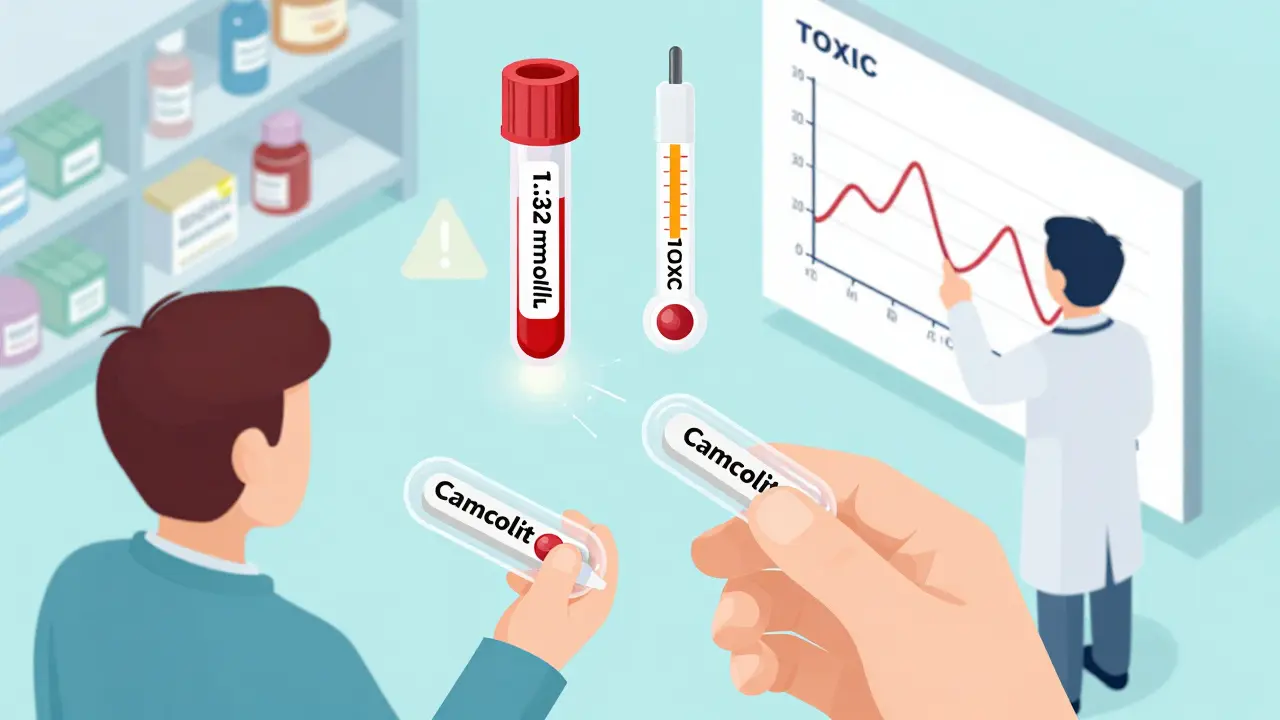
When you're managing bipolar disorder with lithium, the pill you take might look the same as someone else’s - but that doesn’t mean it acts the same way in your body. Generic lithium carbonate is widely used because it’s cheaper, but switching between brands - even if they’re both labeled "lithium carbonate" - can cause your blood levels to swing dangerously high or drop below effective levels. This isn’t a theoretical concern. Real patients have ended up in the hospital after a simple pharmacy substitution. The truth is, lithium carbonate generics aren’t interchangeable in practice, even if they’re legally considered bioequivalent.
Why Lithium Is So Sensitive
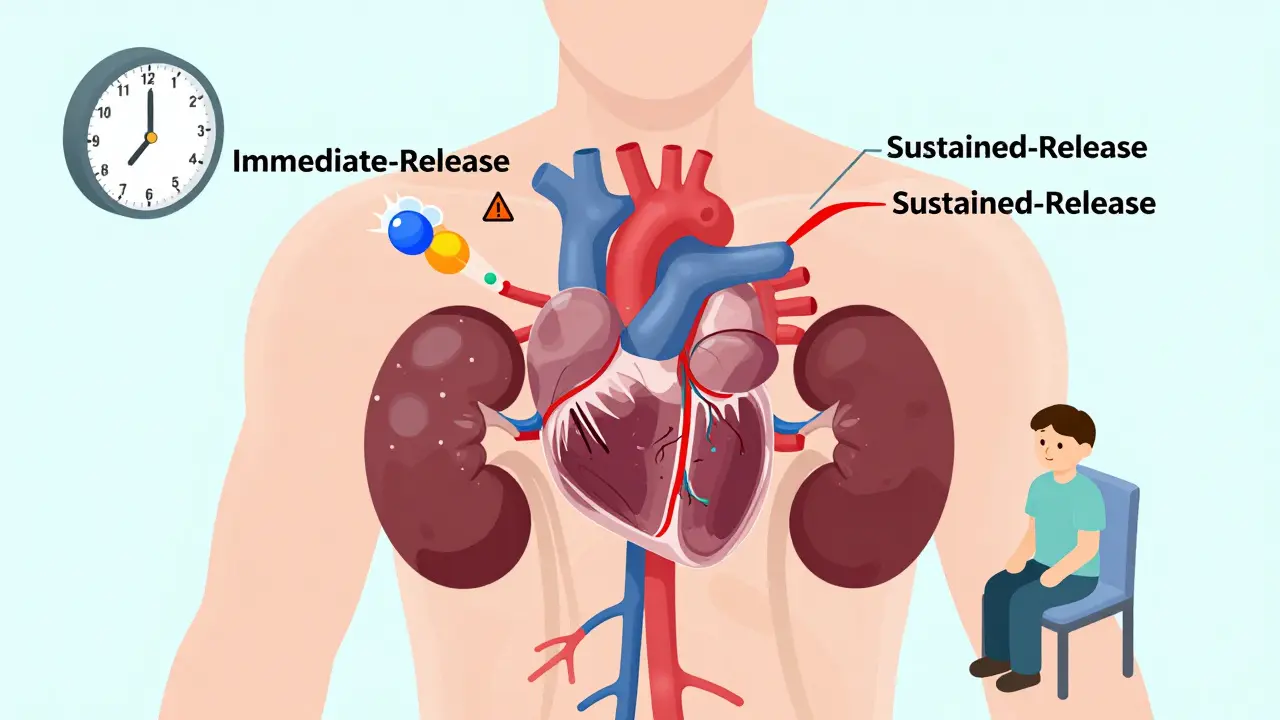
Lithium works by stabilizing mood in bipolar disorder, reducing manic episodes, and preventing depression. It also cuts suicide risk by up to 80% in long-term users. But it’s not like taking a vitamin. Lithium has a razor-thin window between doing its job and poisoning you. The ideal serum level? Between 0.6 and 1.2 mmol/L. Go above 1.5 mmol/L, and you risk tremors, confusion, vomiting, and even seizures. Below 0.6 mmol/L, and you might not feel any benefit at all.This narrow range is why every patient on lithium needs regular blood tests. But here’s where it gets messy: different generic brands release lithium into your bloodstream at different speeds. A standard-release tablet might peak in your blood in 1.5 hours. A sustained-release version? It could take 4 to 5 hours. That delay changes how much lithium builds up in your system over time - even if you take the exact same milligram dose.
Brand Differences That Matter
You might think all lithium generics are created equal. They’re not. Two common sustained-release generics - Camcolit and Priadel - have shown measurable differences in clinical studies. In a 2024 study of over 300 patients, those on Camcolit had, on average, 11% higher serum levels than those on Priadel, even after adjusting for age, weight, and kidney function. That’s not a small difference. For someone already near the top of the safe range, that 11% could push them into toxicity.Even more concerning: one patient in the same study had a lithium level of 1.88 mmol/L after switching from one generic to another. That’s well into dangerous territory. The patient didn’t change their dose. Only the brand did. And because many doctors don’t track which generic they prescribe, patients often get switched without warning - sometimes at the pharmacy, sometimes during a hospital discharge.
It’s not just about peak levels. The total amount of lithium absorbed over time (called AUC) might be similar between generics, but how fast it hits your blood matters. A sudden spike in concentration can cause side effects like nausea or dizziness. A slow, steady release might feel better - but only if you’re consistently on the same formulation.
How Serum Levels Are Measured (And Why Timing Matters)
Your doctor doesn’t just pull blood anytime. The timing of your blood draw is critical. For immediate-release lithium (taken 2-3 times a day), the blood test should be done 12 hours after your last dose - that’s when levels are most stable. For once-daily sustained-release tablets, the test is usually done 24 hours after the dose. Get this wrong, and your result is meaningless.Some patients are tested right after taking their pill. Others get drawn at random times. If you’re on a sustained-release form and your doctor checks your level 6 hours after your dose, you might see a falsely high reading - not because you’re toxic, but because the drug hasn’t fully released yet. That could lead to an unnecessary dose reduction, making you vulnerable to relapse.
Who Needs Lower Levels - And Why
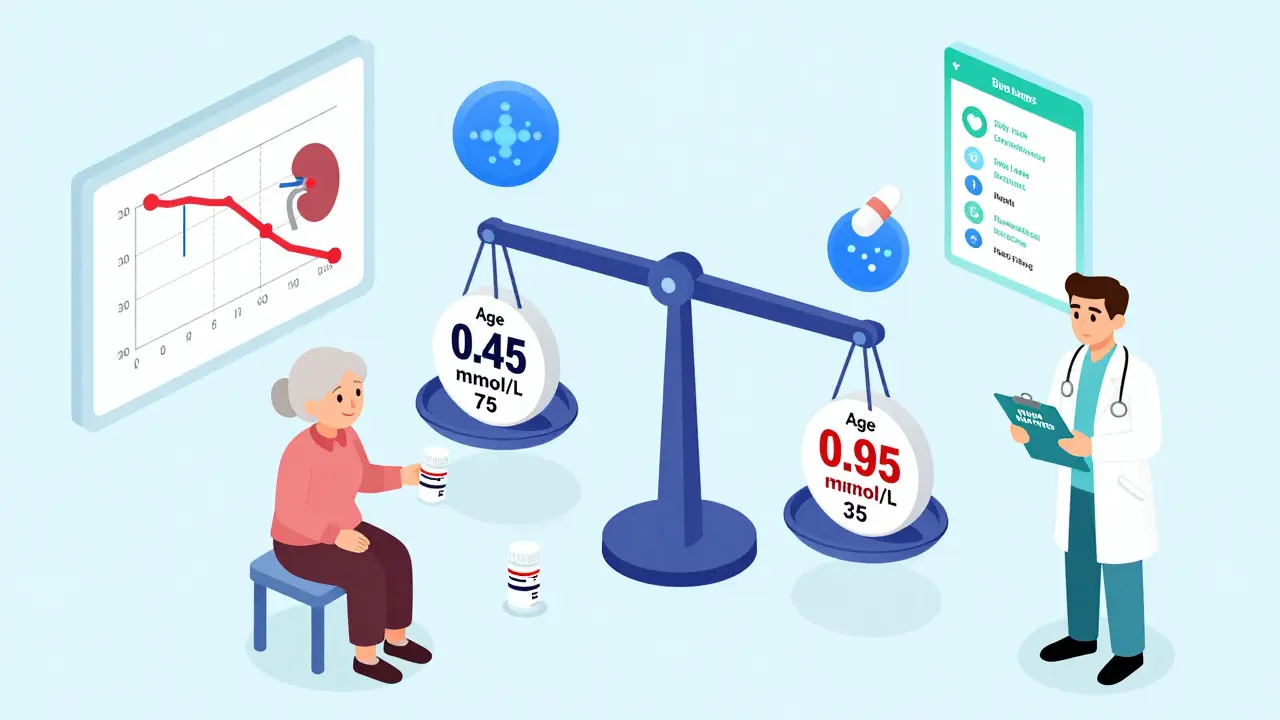
Not everyone should aim for the same target. Age, kidney function, and gender all change how your body handles lithium.Patients over 60 often need lower doses. Kidneys clear lithium slowly with age. A dose that was safe at 40 might be toxic at 75. Experts recommend reducing targets by 20-25% in older adults - meaning a maintenance level of 0.4-0.6 mmol/L instead of 0.6-0.8 mmol/L. Yet many clinics still use the same numbers across all ages.
Women, on average, require lower daily doses than men - about 96 mg less, according to the same 2024 study. Why? Body weight, fat distribution, and hormonal differences affect how lithium is distributed. But again, most prescriptions are based on a one-size-fits-all model.
Even kidney health matters. If your creatinine clearance drops below 50 mL/min, lithium clearance slows. A level that was stable last month could climb next month. That’s why every lithium patient needs a creatinine and eGFR test every 3-6 months. Some newer guidelines now recommend checking cystatin C too - it’s a more accurate marker of kidney function in older adults.
What Happens When You Switch Generics
Let’s say you’ve been on Priadel for two years. Your levels are steady at 0.75 mmol/L. You feel stable. Then, your pharmacy runs out. They switch you to Camcolit - same dose, same pill count. You don’t notice anything different. But two weeks later, you’re dizzy, nauseous, and your hands shake. You go to the ER. Your lithium level? 1.32 mmol/L. Toxic.This isn’t rare. In fact, 12.5% of lithium prescriptions in Europe and North America are written generically without specifying the brand. That means pharmacists can substitute freely. And while the FDA requires generics to be within 80-125% of the brand’s absorption (AUC), that’s a huge range. One study found up to 20% variation in peak levels between two sustained-release generics - even when dosed identically.
The bottom line: if you switch from one generic to another, your serum level should be checked within 1-2 weeks. No exceptions. Even if you’ve been on lithium for decades. Even if you’ve never had side effects before. The chemistry doesn’t care about your history - it cares about the formulation in your hand right now.
Monitoring Isn’t Optional - It’s Lifesaving
Lithium is one of the most effective treatments for bipolar disorder. But it’s also one of the most dangerous if not monitored closely. Here’s what you need to do:- Get your serum lithium level checked every 3-6 months when stable. More often if you’re adjusting doses, sick, or changing formulations.
- Always tell your doctor if your pharmacy switches your brand. Even if you think it’s "the same thing." It’s not.
- Keep a log: note the brand name, dose, and date of your last blood test. Bring it to every appointment.
- Get kidney and thyroid tests every 6 months. Lithium can damage kidneys and cause hypothyroidism.
- Stay hydrated. Dehydration spikes lithium levels. Avoid NSAIDs like ibuprofen - they interfere with kidney clearance.
There’s no perfect solution yet. But the best protection you have is awareness. If your doctor doesn’t ask about your brand, or doesn’t test your levels after a switch - ask them. Push for it. Your mood stability, and possibly your life, depends on it.
What’s Next for Lithium Therapy
Researchers are now looking at genetic markers that predict how someone metabolizes lithium. The International Consortium on Lithium Genetics has identified 30 genes linked to how much lithium you need to stay in range. In the next five years, we may see personalized dosing tools - apps that use your age, weight, kidney function, and genetics to predict your ideal dose.For now, the simplest, most powerful tool remains: consistent monitoring. Don’t assume generics are interchangeable. Don’t wait for symptoms. Test before you assume everything’s fine. Lithium saved millions of lives. But it’s killed some too - because people thought the pill was the same.
Can I switch between lithium generics without checking my blood level?
No. Even though generics are legally considered bioequivalent, real-world studies show they can cause significant changes in serum lithium levels. Switching brands without a follow-up blood test can lead to toxicity or loss of mood control. Always check your level within 1-2 weeks after any formulation change.
What’s the safest lithium serum level for long-term use?
For most adults on maintenance therapy, the safest target is 0.6-0.8 mmol/L. Higher levels (0.8-1.0 mmol/L) may be used during acute episodes, but carry more risk. For patients over 60, a lower range of 0.4-0.6 mmol/L is often recommended due to reduced kidney function. Always follow your doctor’s personalized target.
Why do some people need higher doses of lithium than others?
Dose needs vary based on age, weight, kidney function, and even the specific formulation. Older adults, women, and people with slower kidney clearance often need lower doses. Sustained-release formulations may require higher total daily doses than immediate-release ones to maintain the same blood levels. Genetics also play a role - some people naturally clear lithium faster.
Is lithium still used today with newer medications available?
Yes. Despite newer drugs, lithium remains a first-line treatment for bipolar I disorder, especially for preventing mania and suicide. Studies show it’s more effective than many newer agents at reducing long-term relapse. About 60% of long-term bipolar patients still take lithium. Its low cost and proven track record keep it widely used, even as generics dominate the market.
What should I do if I experience side effects after switching lithium brands?
Contact your doctor immediately. Symptoms like hand tremors, nausea, confusion, or dizziness could signal rising lithium levels. Don’t wait. Get a serum lithium level test within 24-48 hours. Bring the new prescription bottle to your appointment so your doctor can identify the exact formulation. Avoid NSAIDs and dehydration until you’re cleared.
Generic lithium carbonate saves money - but not at the cost of your safety. The pill might look identical, but inside your body, it’s not the same story. Stay informed. Stay tested. Stay alive.
Andrew Muchmore
March 16, 2026 AT 12:41My doctor now asks me the brand name before refills. Small thing. Big difference.
Paul Ratliff
March 17, 2026 AT 00:40pharmas r just playing russian roulette with our brains
SNEHA GUPTA
March 18, 2026 AT 17:29We measure blood pressure down to the mmHg, cholesterol to the mg/dL. Yet we hand out lithium like candy and expect stability. The science is clear. The practice? Lagging.
Gaurav Kumar
March 20, 2026 AT 04:43Stop blaming generics. Blame lazy clinicians. This isn't a US problem. It's a global failure of oversight.
David Robinson
March 21, 2026 AT 06:20My god. I just want to feel normal. Not become a full-time lab technician.
Jeremy Van Veelen
March 21, 2026 AT 10:11Someone died last week because they switched from Camcolit to Priadel. No one told them. No one tested them. Just another statistic in a broken system.
Laura Gabel
March 23, 2026 AT 03:07But I've seen patients come back with side effects. We don't get training on this. No one tells us it matters. Maybe we should.
jerome Reverdy
March 25, 2026 AT 00:46It’s not that generics are bad. It’s that the regulatory framework is designed for ibuprofen, not lithium. We need a separate category for narrow-therapeutic-index drugs. Period.
Andrew Mamone
March 25, 2026 AT 00:58Brand. Dose. Date. Blood test result. I carry it in my wallet. My doctor says I'm obsessive. I say I'm alive.
MALYN RICABLANCA
March 25, 2026 AT 06:57I cried in the ER. I screamed at my psychiatrist. I begged for a brand. No one listened. Now I have a binder. 47 pages. Every test. Every bottle. Every note. If you don't document it, it didn't happen. And I refuse to die because someone thought 'it's the same pill.'
gemeika hernandez
March 26, 2026 AT 17:46Nicole Blain
March 27, 2026 AT 09:22Thank you. You're a unicorn. 🦄
Kathy Underhill
March 29, 2026 AT 09:24Until we treat lithium like insulin-strict, monitored, tracked-we'll keep losing people to preventable toxicity. It's not about chemistry. It's about systems.