

Imagine looking out a window and seeing the world as if it’s blurred through a cracked mirror. That’s what life can feel like with keratoconus-a condition where the cornea, the clear front surface of your eye, slowly bulges outward into a cone shape. It doesn’t happen overnight. It starts subtly, often in the teens or early twenties, and gets worse over years. Glasses stop helping. Soft contacts slip around. Vision gets foggy, doubled, or sensitive to light. By the time many people realize something’s wrong, their cornea has already thinned and warped. But here’s the good news: rigid lenses can restore clear vision for most people-even when the cornea is badly shaped.
What Actually Happens in Keratoconus?
Your cornea isn’t supposed to be pointy. It’s meant to be smooth and dome-shaped, like a perfect half-sphere, to focus light precisely onto the retina. In keratoconus, the collagen fibers that hold it in place weaken. Enzymes start breaking down the tissue faster than the body can repair it. The result? The center of the cornea thins and pushes forward, forming a cone. This distortion throws off how light enters your eye, causing blurry, distorted vision that glasses can’t fix. It usually affects both eyes, but one eye often gets worse faster. The progression slows down by your 30s or 40s, but by then, many people have already lost significant vision. Corneal topography scans show the pattern clearly: the steepest part is in the center or lower part of the cornea, with thinning radiating outward. Without treatment, the surface can develop scars, making vision even worse.Why Regular Glasses and Soft Contacts Don’t Work
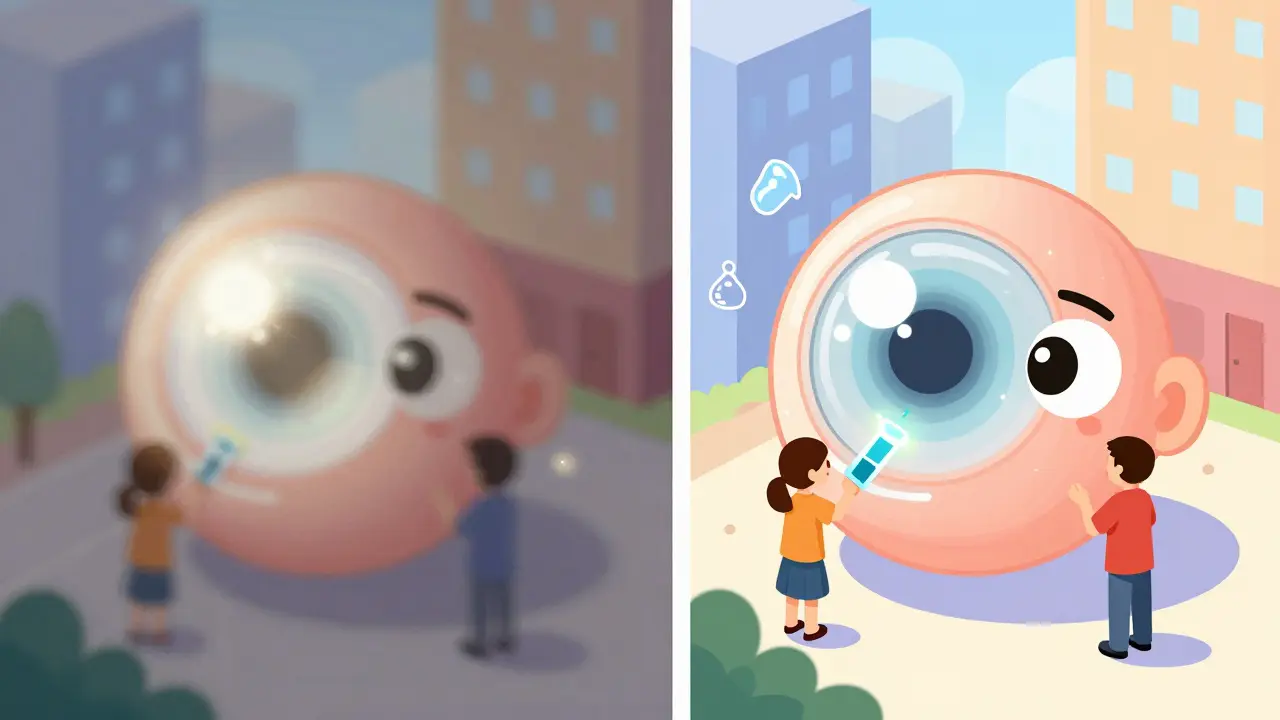
Glasses correct vision by bending light evenly. But if your cornea is uneven, light hits your retina at different angles. Glasses can’t fix that. Soft contact lenses? They conform to the shape of your cornea. So if your cornea is cone-shaped, the soft lens just follows the curve-and so does the blur. That’s where rigid lenses come in. They don’t mold to your eye. They float on top of it, creating a new, smooth optical surface. Think of it like putting a clear, rigid dome over a crooked surface. The space between the lens and your cornea fills with tears, which act as a liquid buffer. This smooths out the irregularities and lets light focus properly again.The Three Types of Rigid Lenses Used for Keratoconus
Not all rigid lenses are the same. There are three main types used today, each suited for different stages of the disease.- Rigid Gas Permeable (RGP) Lenses: These are the classic choice. Small, usually 9-10mm wide, made from oxygen-permeable plastic. They sit directly on the cornea. Dk values (oxygen flow ratings) range from 50 to 150-high enough to keep the cornea healthy during wear. They offer sharp vision and are often the first option tried.
- Hybrid Lenses: These have a rigid center (like an RGP) surrounded by a soft skirt. They give you the clarity of a rigid lens with the comfort of a soft one. Good for people who find RGPs too uncomfortable but still need clear vision.
- Scleral Lenses: These are bigger-15 to 22mm wide. They don’t touch the cornea at all. Instead, they vault over it and rest on the white part of the eye (the sclera). The space between the lens and the cornea holds a reservoir of saline solution, which keeps the cornea moist and protected. This is the go-to for advanced keratoconus, scarring, or extreme sensitivity.
Studies show that scleral lenses have an 85% success rate in advanced cases (Stage III-IV), while traditional RGPs work in about 65% of those same cases. But RGPs are still the starting point for most patients because they’re easier to fit and less expensive.
How Rigid Lenses Compare to Other Treatments
There are other options, but none replace rigid lenses for vision correction.- Corneal Cross-Linking (CXL): This is the only treatment proven to stop keratoconus from getting worse. It uses UV light and riboflavin to strengthen the cornea’s collagen fibers. Success rate? 90-95% at five years. But it doesn’t improve your vision-you still need lenses after.
- INTACS: Tiny plastic rings are inserted into the cornea to flatten the cone. It helps some, but 35-40% of patients still need rigid lenses afterward.
- Corneal Transplant: For the 10-20% of people who can’t wear lenses or have severe scarring, a transplant replaces part or all of the cornea. But recovery takes over a year. There’s a 5-10% risk of rejection. And even after surgery, many still need rigid lenses for clear vision.
Rigid lenses aren’t a cure. But they’re the most reliable way to get back your daily vision-without surgery. Most eye doctors now recommend combining CXL with rigid lenses: stop the disease, then correct the vision.
What to Expect When You Start Wearing Rigid Lenses
Adapting isn’t easy. The first week is rough. You’ll feel like there’s something in your eye. Your vision might flicker. You’ll need to practice inserting and removing them. About 30% of people quit in the first month because of discomfort. But here’s the reality: 85% of those who stick with it get to full-time wear within 2-4 weeks. Start with just 2-4 hours a day. Add an hour every couple of days. Use rewetting drops. Don’t force it. Common complaints:- Foreign body sensation (45% of new wearers)
- Lens awareness (38%)
- Difficulty inserting/removing (32%)
- Lens fogging (25%)
- Lens decentration (15%)
Most of these fade. If they don’t, your fitter can tweak the lens design. New digital manufacturing lets labs build lenses based on your exact corneal scan-something approved by the FDA in early 2023. That means better fit, less irritation.
Long-Term Results and Real-Life Outcomes
People who stick with rigid lenses don’t just see better-they live better. Pre-fitting, many patients can’t read the big E on the eye chart. Average vision? Around 20/80. After adaptation, most reach 20/25 or better. Some hit 20/20. Light sensitivity drops. Driving at night becomes possible. Reading without squinting? That happens too. One patient in Sydney, 28, started with RGPs after her vision dropped to 20/400. Within six weeks, she was driving again. She switched to sclerals a year later when her cornea got more irregular. Now, five years on, she’s working full-time, traveling, and hasn’t needed surgery.
Who Should Avoid Rigid Lenses?
They’re not for everyone.- People with severe dry eye-lenses can make it worse.
- Those with extreme corneal scarring-lenses won’t center properly.
- Anyone who can’t handle the routine: cleaning, disinfecting, daily wear.
Failure rates are 15-25% in advanced cases. But that’s often because the wrong lens type was tried first. Starting with RGPs in stage III? That’s asking for trouble. Sclerals are the better choice then.
The Future of Rigid Lenses for Keratoconus
Technology is improving fast. New materials now allow oxygen permeability (Dk) over 200-way higher than before. That means longer wear, fewer complications. Custom digital lenses, made from 3D scans of your cornea, are becoming standard. Companies like BostonSight and Contex are pushing these forward. And the demand is growing. About 1 in 2,000 people have keratoconus. In the U.S., 70% of diagnosed patients use rigid lenses long-term. The global market for these specialty lenses is expected to hit $2.78 billion by 2027. The message from specialists is clear: rigid lenses aren’t outdated. They’re evolving. And for most people with keratoconus, they’re still the best, safest, most effective way to see clearly.What to Do Next
If you’ve been told you have keratoconus:- Get a corneal topography scan. This maps your cornea’s shape.
- See a specialist in contact lenses for keratoconus-not just any optometrist.
- Ask about combining CXL with lens fitting. Do both together.
- Start with RGPs. If they don’t work after 6-8 weeks, try sclerals.
- Don’t give up after a bad first week. Adaptation takes time.
Most people who stick with it never need a transplant. And that’s the goal: keep your own cornea, keep your vision, keep your life.
Can keratoconus be cured with rigid lenses?
No, rigid lenses don’t cure keratoconus. They correct the vision loss caused by the irregular cornea, but they don’t stop the thinning. To halt progression, you need corneal cross-linking (CXL). Most eye doctors recommend doing both: CXL to stop the disease, and rigid lenses to restore clear vision.
Are scleral lenses better than RGP lenses for keratoconus?
It depends on the stage. For early to moderate keratoconus, RGP lenses often work well and are easier to fit. For advanced cases-with scarring, extreme thinning, or discomfort with RGPs-scleral lenses are superior. They vault over the cornea, reducing irritation and offering better stability. Success rates for sclerals in advanced cases are around 85%, compared to 65% for RGPs.
How long does it take to get used to rigid contact lenses?
Most people need 2 to 4 weeks to adapt. Start with just 2-4 hours a day and increase by 1-2 hours every few days. Discomfort, foreign body sensation, and lens awareness are normal at first. If you’re still struggling after a month, your lens may need adjustment. Don’t quit too soon-85% of patients who stick with it achieve full-time comfort.
Can I wear rigid lenses while sleeping?
No. Rigid lenses, including sclerals, should never be worn overnight. Your cornea needs oxygen, and sleeping in lenses increases the risk of infection, ulcers, and hypoxia. Always remove them before bed, clean them, and store them in fresh solution.
Do I need to get new lenses every year?
Not necessarily. Rigid lenses last 1-3 years if cared for properly. But if your keratoconus progresses, your cornea changes shape, and you’ll need a new fit. Most patients return for a check-up every 6-12 months. If your vision blurs or the lens feels uncomfortable, don’t wait-get it checked.
Is there a chance I’ll need a corneal transplant?
Only about 10-20% of people with keratoconus eventually need a transplant. That’s usually because they couldn’t tolerate lenses or developed severe scarring. With early CXL and proper lens fitting, most people avoid surgery entirely. Transplants are a last resort-not the goal.
Tony Du bled
December 22, 2025 AT 06:27Rigid lenses changed my life. I was at 20/400 before I even tried them. First week was hell-felt like sand in my eyes. But by week three, I was driving at night without glare. No surgery. No miracle. Just science and patience. I’m 31 now, still wearing the same pair of RGPs. They’re not glamorous, but they work.
People act like it’s 1995. It’s not. Modern lenses are custom-molded from 3D scans. Your eye gets its own tiny dome. It’s wild when you think about it.
Nader Bsyouni
December 24, 2025 AT 01:23So we’re just gonna keep slapping plastic on our eyeballs instead of fixing the root cause huh
Meanwhile the cornea is still slowly dying under there like a rotten apple in a drawer
They call it vision correction but it’s just a fancy bandaid on a hemorrhaging artery
And don’t get me started on the corporate lens market pushing this like it’s the only option
They don’t want you cured they want you dependent
Herman Rousseau
December 25, 2025 AT 15:18Hey I just wanna say this is one of the most helpful posts I’ve seen on this topic
Big shoutout to the author for breaking it down so clearly
For anyone scared to start rigid lenses-you’re not alone. I cried the first time I tried to put one in. Took me 20 minutes. My dog watched like I was performing surgery.
But here’s the thing: it gets better. Like, way better. I went from not recognizing my own face in the mirror to reading street signs from a block away. And the sclerals? Game changer. My optometrist said I had Stage III and I thought I was doomed. Nope. Just needed the right lens.
Don’t quit after a week. Your eyes need time to adjust like a new pair of shoes. And if your fitter doesn’t use digital mapping? Find a new one. It makes all the difference.
You got this. Seriously. I’m living proof.
Vikrant Sura
December 27, 2025 AT 03:15Yeah whatever. I tried RGPs. Didn’t work. Got a transplant. Done. This whole post feels like an ad for lens companies.
Candy Cotton
December 27, 2025 AT 21:49It is imperative to note that the efficacy of rigid gas permeable lenses is not universally applicable and must be evaluated within the context of rigorous clinical protocols. Furthermore, the assertion that 85% of patients achieve 20/25 vision is statistically misleading without citation of peer-reviewed longitudinal studies. The American Academy of Ophthalmology does not endorse blanket recommendations for lens use without individualized topographical assessment. One must consider the socioeconomic implications of high-cost specialty lenses in underinsured populations. This post, while seemingly informative, lacks academic rigor and ethical responsibility.
Jeremy Hendriks
December 28, 2025 AT 21:31Think about it. We’re talking about a body part that’s literally transparent. A window made of living tissue. And we’ve turned it into a problem that needs a mechanical fix. We don’t fix nature. We hack it.
That’s the real story here. Not the lens. Not the CXL. The fact that we’ve accepted that our eyes are broken machines that need tuning. We don’t heal. We retrofit.
And now we’re selling these custom-fit plastic domes like they’re the next iPhone. But here’s the twist: the cornea doesn’t want to be fixed. It just wants to be left alone. We’re the ones who broke it with screens and rubbing and poor sleep and stress.
Maybe the real cure is not in the lens… but in the way we live.
Aliyu Sani
December 29, 2025 AT 06:53bro i had keratoconus in nigeria and no one knew what it was
my dad took me to a pharmacy and they sold me blue contacts that felt like sandpaper
then i got a scholarship to usa and the first optometrist i met asked for my topography scan like it was normal
they put me on rgps and i cried for 3 days but now i see my baby’s face without squinting
if you in africa and you got this-dont give up. go to a big city. find a hospital. they got programs. i got mine through a ngo
its not magic. its just access. and you deserve it
Gabriella da Silva Mendes
December 30, 2025 AT 23:06Okay but let’s be real-this whole thing is just a $$$ scheme. 🤡
First they tell you glasses won’t work. Then they tell you soft contacts are useless. Then they drop the bomb: ‘You need a $1,200 lens that you have to clean every night and can’t sleep in.’
And don’t get me started on CXL-$3,000 to ‘stop it from getting worse’-which sounds like a warranty for your eyeballs.
Meanwhile, my cousin in Texas got a transplant and now she’s basically blind again because her body rejected it. So now she’s back on sclerals. So what did we even accomplish?
And don’t tell me ‘it’s worth it’-I’ve seen the receipts. The insurance battles. The monthly replacement fees. The fact that you can’t even go swimming without losing your lens in the pool.
They sell hope. But the real product? A lifetime of maintenance. 🫠
Also-why is everyone so obsessed with 20/20? Can’t we just learn to live with blurry? I mean, I’ve been seeing the world like a watercolor painting since I was 16. It’s kinda beautiful. 😌