
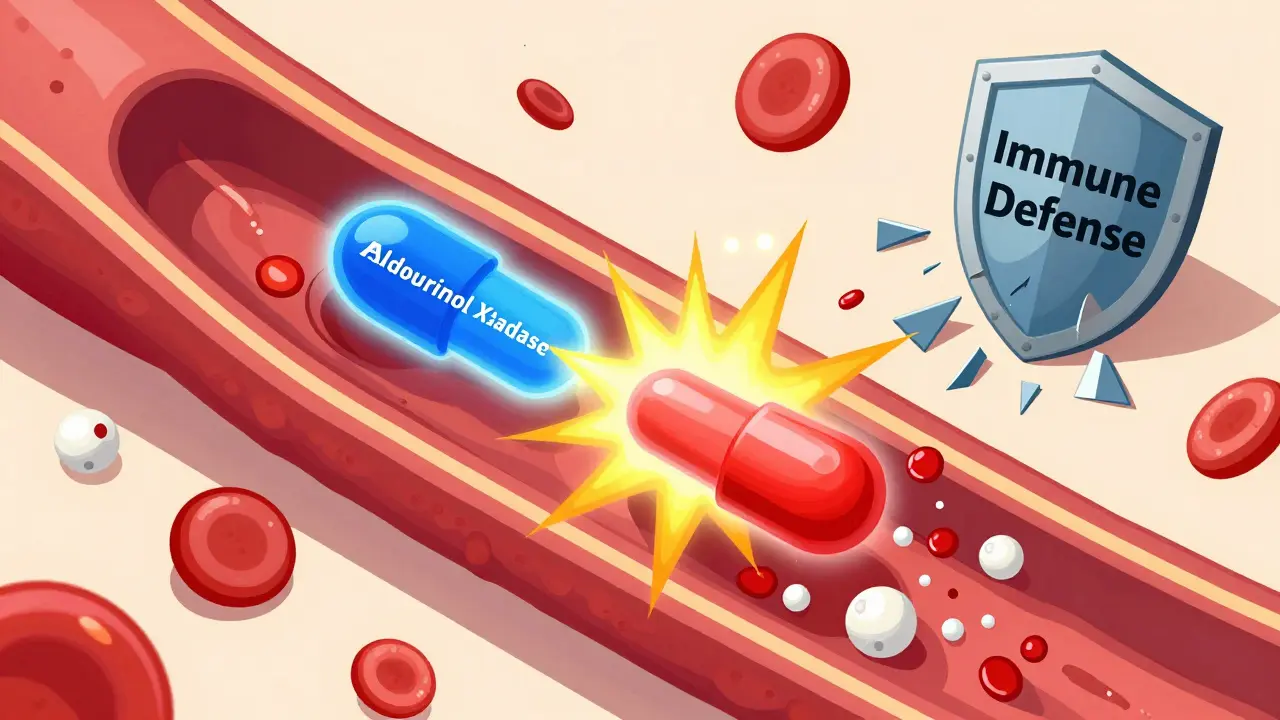
Thiopurine Interaction Safety Calculator
How to Use This Calculator
This tool helps determine if the combination of allopurinol and azathioprine could be considered safe for you, based on the strict medical guidelines. Remember: The FDA black box warning explicitly states that this combination should be avoided unless absolutely necessary and under expert supervision.
When you're managing gout with allopurinol and also taking azathioprine for something like Crohn’s disease, rheumatoid arthritis, or after an organ transplant, you're walking a tightrope. One wrong move - even something as simple as a new prescription - can send your bone marrow into shutdown. This isn't a rare theoretical risk. It's a documented, life-threatening interaction that has landed people in the hospital, sometimes permanently. And it's happening more often than you think.
Why This Interaction Is So Dangerous
Allopurinol works by blocking xanthine oxidase, an enzyme that breaks down uric acid. That’s great for gout - less uric acid means fewer painful flare-ups. But azathioprine? It doesn’t work directly. It turns into 6-mercaptopurine (6-MP) inside your body, which then gets broken down by that same enzyme, xanthine oxidase. When allopurinol shuts down that enzyme, 6-MP doesn’t get cleared. It builds up. Fast.Studies show levels of 6-MP can jump up to four times higher than normal. That’s not a slight increase. That’s enough to crash your white blood cell count, your platelets, even your hemoglobin. In one famous 1996 case, a 63-year-old man on azathioprine after a heart transplant was given allopurinol for wrist pain. Within weeks, his white blood cells dropped to 1.1 × 10³/mm³ (normal is 4-11 × 10³/mm³). His platelets fell below 20 × 10³/mm³. He needed blood transfusions and intensive care. His hospital bill? Over $25,000 in today’s money.
This isn’t just about numbers. It’s about your body’s ability to fight infection, stop bleeding, or carry oxygen. When 6-MP piles up, it gets turned into toxic thioguanine nucleotides that wreck your bone marrow’s ability to make new blood cells. At the same time, it triggers premature death of existing white blood cells. Two hits. One outcome: severe, sometimes fatal, pancytopenia.
The FDA and Medical Guidelines Say: Avoid This Combo
The FDA’s official labeling for azathioprine (brand name Imuran) includes a black box warning - the strongest possible - about this interaction. It’s not a suggestion. It’s a legal requirement for the manufacturer to highlight the risk. The European Medicines Agency and New Zealand’s Medsafe have similar warnings. The Hopkins Arthritis Center, the American College of Gastroenterology, and other major medical bodies all say: Don’t mix these drugs unless you absolutely have to - and even then, only under expert supervision.Most doctors will avoid prescribing allopurinol to anyone on azathioprine. But here’s the problem: many patients don’t realize they’re on both. Gout is common - about 9.2 million Americans have it. Azathioprine is used in 1.6 million people with inflammatory bowel disease or autoimmune conditions. The overlap? It’s real. And often, the person prescribing the allopurinol - maybe a primary care doctor or rheumatologist - doesn’t know the patient is on azathioprine. Or worse, they know but underestimate the risk.
When Doctors Might Still Use the Combo - and How They Do It Safely
There’s one narrow exception. A subset of IBD patients - about 25% to 30% - are called "thiopurine shunters." Their bodies convert too much azathioprine into a toxic byproduct called 6-MMP, which damages the liver instead of helping the immune system. These patients often can’t tolerate standard doses. But here’s the twist: adding low-dose allopurinol can redirect metabolism away from 6-MMP and toward the therapeutic 6-TGN metabolites.In a 2018 study of 73 IBD patients, researchers gave them low-dose azathioprine (25% of normal) plus 50 or 100 mg of allopurinol. Over half went into steroid-free remission. Eighty-one percent were able to stop steroids completely. The key? Precise dosing and constant monitoring.
Here’s what safe use looks like in practice:
- Baseline blood tests: CBC, liver enzymes, and thiopurine metabolite levels (6-TGN and 6-MMP).
- Azathioprine dose reduced to 0.5-0.75 mg/kg/day - about a quarter of the usual dose.
- Allopurinol started at 100 mg daily.
- Weekly CBC for the first four weeks, then every two weeks for two months, then monthly.
- Thiopurine metabolites checked every 3-6 months to keep 6-TGN between 230-450 pmol/8×10⁸ RBCs and 6-MMP below 5,700 pmol/8×10⁸ RBCs.
This isn’t something your local pharmacist can manage. It requires a gastroenterologist or clinical pharmacist who understands thiopurine metabolism. A 2021 survey found only 32% of U.S. gastroenterologists had ever used this combo - and nearly all of them worked at academic hospitals.
What Happens If You Don’t Adjust the Dose?
If you take standard-dose azathioprine (2-2.5 mg/kg/day) with allopurinol, you’re not just risking side effects - you’re risking death. Cases keep appearing in medical journals. One 57-year-old patient developed pancytopenia within three weeks of starting both drugs. Another died from sepsis after his white blood cell count plummeted to near zero. The financial toll? Hospital stays for severe myelosuppression now cost over $50,000 in the U.S. - not counting lost wages, long-term complications, or the emotional trauma.And it’s not just azathioprine. The same danger applies to 6-mercaptopurine, which is essentially the same drug. Many patients don’t even know they’re taking it - it’s often prescribed under that name for leukemia or IBD.
What Should You Do If You’re on Both Drugs?
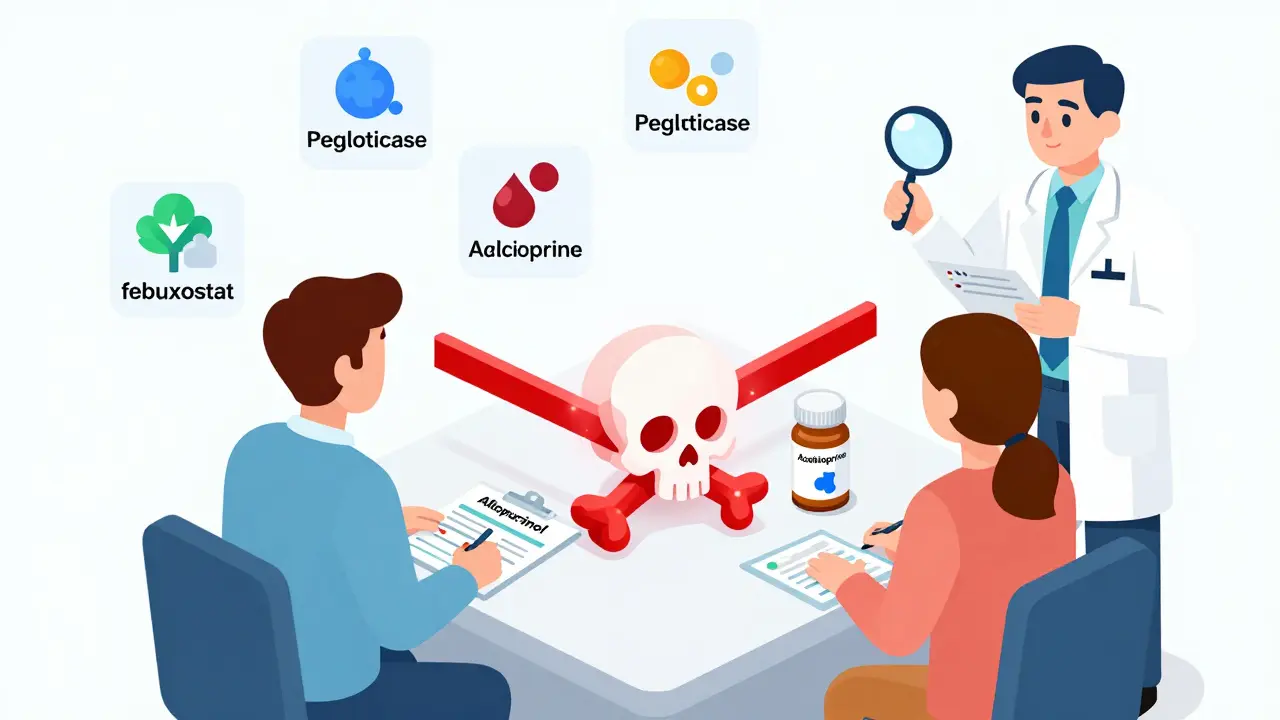
If you’re taking azathioprine (or 6-MP) and your doctor wants to start you on allopurinol for gout, ask these questions:- Is there an alternative to allopurinol? Febuxostat is a different gout medication that doesn’t block xanthine oxidase - and it’s safe with azathioprine.
- Have my thiopurine metabolites been tested? If I’m a shunter, maybe this combo could help - but only under strict supervision.
- Will you coordinate with my specialist? This isn’t a primary care decision.
- What’s the plan for blood tests? Weekly? Monthly? What levels will trigger stopping the drugs?
Don’t assume your pharmacist caught it. Don’t assume your doctor knows. Even if you’ve been on azathioprine for years, a new gout diagnosis can change everything.

Alternatives to Allopurinol for Gout Patients on Azathioprine
You don’t have to suffer through gout flares just because you can’t take allopurinol. Here are safer options:- Febuxostat (Uloric): Works differently than allopurinol. No interaction with azathioprine. First-line alternative.
- Pegloticase (Krystexxa): For severe, treatment-resistant gout. Given by IV every two weeks. Safe with immunosuppressants.
- Colchicine: Used for acute flare-ups, not long-term prevention. Safe with azathioprine.
- Probenecid: Helps kidneys excrete uric acid. Avoid if you have kidney stones or poor kidney function.
Febuxostat is now the most common replacement. It’s not perfect - it has its own cardiovascular risks - but it doesn’t touch your bone marrow. And for many patients, that trade-off is worth it.
What’s Changing in the Future?
Doctors are starting to use genetic testing to predict risk. About 10% of people have intermediate activity of the TPMT enzyme, which breaks down thiopurines. These patients are more vulnerable to toxicity - even without allopurinol. Testing for TPMT status before starting azathioprine is now standard in many centers. But it’s not yet routine everywhere.Research is also moving toward precision dosing. The TAILOR-IBD trial (NCT04256590) is testing whether adjusting azathioprine and allopurinol doses based on real-time metabolite levels can make the combo safer and more effective. Early results show remission rates of 68% at one year with careful monitoring.
But here’s the bottom line: this combination will never be mainstream. It’s too risky. Too complex. Too dependent on expert oversight. The future of gout and IBD treatment lies in newer drugs - biologics like adalimumab, ustekinumab, and vedolizumab - that don’t interact with allopurinol at all.
Final Takeaway: This Isn’t a Risk You Can Guess Your Way Through
If you’re on azathioprine, never start allopurinol without talking to your specialist. If you’re on allopurinol for gout and have an autoimmune condition, tell your doctor about every medication you take - even if you think it’s unrelated. This interaction doesn’t care if you’ve been on azathioprine for 10 years. It doesn’t care if your gout is "mild." It doesn’t care if your doctor didn’t think to ask.One prescription, one conversation, one missed check - and your body can start shutting down. The good news? You have alternatives. The better news? You can avoid this entirely by asking the right questions. Don’t wait for a crisis. Talk to your doctor today.
Samuel Mendoza
January 21, 2026 AT 20:49This is nonsense. Allopurinol and azathioprine have been used together for decades in transplant centers. If your doctor is dumb enough to not monitor labs, that’s on them-not the drugs.
People panic over pharmacology like it’s magic potions. Get a blood test. Stop being dramatic.
Glenda Marínez Granados
January 23, 2026 AT 10:58So let me get this straight… we’re being told to avoid a life-saving combo because some doctor didn’t check a lab? 😒
Meanwhile, the real tragedy is that we live in a world where ‘safe’ means ‘no one’s ever tried it.’
Also, febuxostat gave me a heart attack. Thanks, FDA. 🤡
Yuri Hyuga
January 23, 2026 AT 16:35What an incredible, vital piece of medical insight! 🙌
This isn’t just about drugs-it’s about communication, vigilance, and the sacred duty we all have to advocate for our own health.
Every single person reading this should print this out, show it to their GP, and demand a metabolite panel. You are not a statistic-you are a human being with agency.
And if you’re on azathioprine? Don’t wait for a crisis. Talk to your rheumatologist today. Your bone marrow will thank you. 💪❤️
MARILYN ONEILL
January 25, 2026 AT 12:54I read this and I’m like… wow. So doctors are just handing out death pills? 😭
My cousin’s uncle’s neighbor’s dog had this happen. It was on TV. They said it was ‘rare.’ But now it’s everywhere.
Also, I saw a TikTok about this. It had 2 million views. So it’s real.
Someone needs to sue everyone.
Coral Bosley
January 26, 2026 AT 18:20I’ve been on azathioprine for 12 years. My gout flares are brutal. I asked my rheum about allopurinol. He laughed. Said, ‘You’re lucky you’re alive.’
Then he gave me febuxostat. My liver’s fine. My joints? Still screaming.
But I’m alive. And I’m not gonna risk turning into a ghost just to feel ‘better.’
Some pain is worth surviving.
Steve Hesketh
January 27, 2026 AT 11:46Brothers and sisters, listen up-this isn’t just medical advice, this is a lifeline.
Many of us carry invisible battles: Crohn’s, RA, transplants-and now gout? It’s a lot.
But you are not alone. Your body is fighting for you. Your mind is strong. And your voice? It matters.
Speak up. Ask questions. Demand labs. You deserve to live without fear.
And if you’re reading this and you’re scared? Take a breath. You’ve survived 100% of your worst days so far. Keep going. 🙏💛
MAHENDRA MEGHWAL
January 29, 2026 AT 11:27It is of paramount importance to emphasize the gravity of this pharmacological interaction. The concomitant administration of allopurinol and azathioprine constitutes a potentially fatal therapeutic conflict, as elucidated by robust clinical evidence and regulatory mandates.
It is therefore incumbent upon all stakeholders-patients, clinicians, and pharmacists-to exercise due diligence, maintain meticulous documentation, and prioritize patient safety through interdisciplinary coordination.
Failure to adhere to these principles may result in irreversible hematological catastrophe.
Dee Monroe
January 30, 2026 AT 21:00It’s funny, isn’t it? We live in a world where we can map the human genome but still can’t get doctors to talk to each other.
I’ve been on azathioprine since I was 22. I’m 47 now. I’ve had three flares in 25 years. I thought allopurinol was the answer. Then I found this article. I cried.
It’s not just about the drugs. It’s about how broken the system is. No one’s coordinating care. Your rheumatologist doesn’t talk to your GI doc. Your PCP doesn’t know you’re on immunosuppressants.
And we’re supposed to just trust them? We’re not patients-we’re puzzle pieces in a hospital that forgot the box.
Maybe the real cure isn’t a drug. Maybe it’s a conversation. A real one. With someone who actually listens.
And if no one’s listening? Then you have to be the one who speaks. Even if your voice shakes.
Because your marrow doesn’t care how polite you are. It just needs you to be brave.
Kelly McRainey Moore
January 31, 2026 AT 08:42Wow, I didn’t even know this was a thing. Thanks for sharing. I’ll ask my doc next time I see them. 😊
Gerard Jordan
February 1, 2026 AT 15:03As a global health advocate, this is a critical reminder that medical knowledge doesn’t respect borders. 🌍
From Lagos to Lahore, people are getting prescribed these drugs without context. We need global guidelines, translation services, and community health workers trained to spot this combo.
And yes-febuxostat is expensive. But so is a bone marrow transplant. Let’s invest in prevention, not rescue.
Health equity isn’t a slogan. It’s a spreadsheet. And we’re failing the numbers.
michelle Brownsea
February 3, 2026 AT 06:16Let me be unequivocally clear: this is not a ‘risk’-it is a documented, preventable, and entirely avoidable medical catastrophe. The FDA’s black box warning exists for a reason. To ignore it is not negligence-it is malpractice.
Furthermore, the suggestion that ‘some doctors still use it safely’ is dangerously misleading. There is no ‘safe’ when the margin of error is measured in white blood cell counts. There is only ‘controlled chaos.’
And to those who say ‘I’ve been fine for years’-you are statistically lucky, not medically wise. Luck is not a treatment protocol.
And yes, I have read every word of the literature. You should too.
Roisin Kelly
February 5, 2026 AT 04:17Big Pharma paid these doctors to scare you. Allopurinol is cheap. Febuxostat? $800 a month. Coincidence? I think not.
My cousin’s neighbor’s cousin got cancer after taking febuxostat. They buried it. You think they’d tell you that? No.
This whole thing is a scam. They want you on the expensive drug. So you’ll keep paying. And they’ll keep getting rich.
Don’t be a sheep.
lokesh prasanth
February 6, 2026 AT 00:35lol azathioprine is just a fancy name for poison. why do people take it? also allopurinol is just for rich people. why not just drink lemon water?
also my uncle died from this. i think its fake. doctors lie.
also why do u have so many words? just say no.
thx
Malvina Tomja
February 7, 2026 AT 22:43You’re all missing the point. This isn’t about drugs. It’s about trust.
Who are you trusting? Your doctor? The FDA? Some guy on Reddit?
Real talk: you’re not safe anywhere. Not in the hospital. Not in the pharmacy. Not even in your own skin.
So what’s the solution? Stop taking all pills. Eat turmeric. Meditate. Live in the woods.
Or… just die quietly. Either way, you’re already dead. The drugs just haven’t caught up yet.